Beyond the Track: Why Planar Magnetic Levitation Is Rewriting the Rules of Flexible Manufacturing
A technical deep-dive into RobustMotion's MagiFloater® platform — and why the most consequential shift in precision transport isn't about moving faster. It's about moving differently.
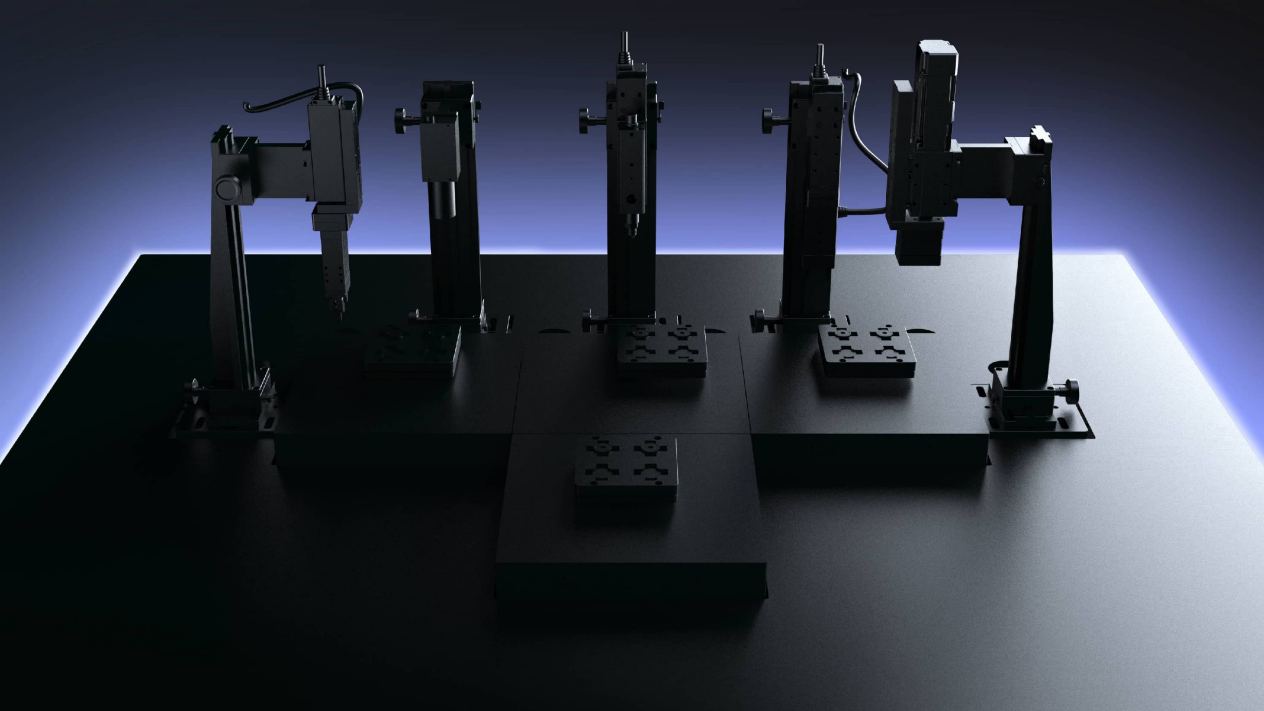
The Conveyor Problem Nobody Wants to Talk About
If you've spent any time commissioning or upgrading a high-mix production line, you already know the drill. The product changes, the line reconfiguration begins, and somewhere between the mechanical redesign, the cable rerouting, and the IPA sign-off, three weeks disappear from your project schedule.
This is the invisible tax of conventional conveyance — and it's far more expensive than most project estimates admit.
Consider what a typical precision assembly or packaging line actually contends with:
Rigid path architecture. Linear conveyors, belt systems, and even magnetic track-based transfer systems constrain product flow to predetermined routes. When a new SKU requires an additional inspection step, a longer dwell time at station three, or a completely different station sequence, you're not adjusting parameters — you're moving steel. Guides get re-cut. Mounting holes get re-drilled. Mounting brackets get fabricated. The mechanical infrastructure that was supposed to last ten years becomes a recurring CapEx line item every time the product portfolio shifts.
The contamination trap. Every mechanical contact point is a potential particle generator. Belt dust, guide wear debris, chain lubrication residue — in a pharmaceutical cleanroom or food-grade facility, each of these is a compliance event waiting to happen. The countermeasure is maintenance: scheduled belt replacements, guide inspections, lubrication protocols. Maintenance means downtime. Downtime means lost throughput.
Single-degree-of-freedom thinking. Conventional conveyance moves things from point A to point B. That's it. If your process requires a product to be repositioned, rotated, tilted, or held at a precise angle — you need a separate mechanism at each station: a rotary index, a tilt fixture, a pick-and-place. Each mechanism adds actuators, sensors, wiring, and integration complexity. The conveyor doesn't participate in the process — it merely feeds it.
The scaling paradox. Want to increase throughput? Add more stations in parallel. But parallel stations mean more floor space, more movers, more coordination logic, and — critically — more transfer points between conveyors. Every transfer point is a potential jam, misalignment, or contamination source. You don't scale linearly. You scale geometrically in complexity.
These aren't edge cases. They're the daily reality of running flexible manufacturing in regulated industries. And they share a common root cause: the fundamental architecture of track-based, mechanically-contact conveyance hasn't changed in decades.
Enter Planar Magnetic Levitation
The principle is deceptively simple. Instead of constraining motion to a physical track, use a grid of electromagnetic coils to generate a precisely controlled field across a flat surface. A passive mover — containing a permanent magnet array — levitates above that surface and moves freely in any direction.
No tracks. No guides. No belts. No contact.
This isn't theoretical. RobustMotion's MagiFloater® platform is a commercially deployed planar maglev system built around modular 262 × 262 mm stator tiles that can be assembled into working surfaces of virtually any size and geometry. Each independent mover (104 × 104 mm) levitates 0.5–5 mm above the surface and achieves six degrees of freedom:
| Axis | Motion |
|---|---|
| X, Y | Free planar translation |
| Z | Vertical displacement |
| R(X), R(Y) | Tilt (±2°) |
| R(Z) | Rotation (±15°) |
The specifications tell part of the story — ±20 μm positioning accuracy, 1.5G acceleration (unloaded), 600 g payload per mover — but the real significance lies in what this architecture eliminates rather than what it adds.
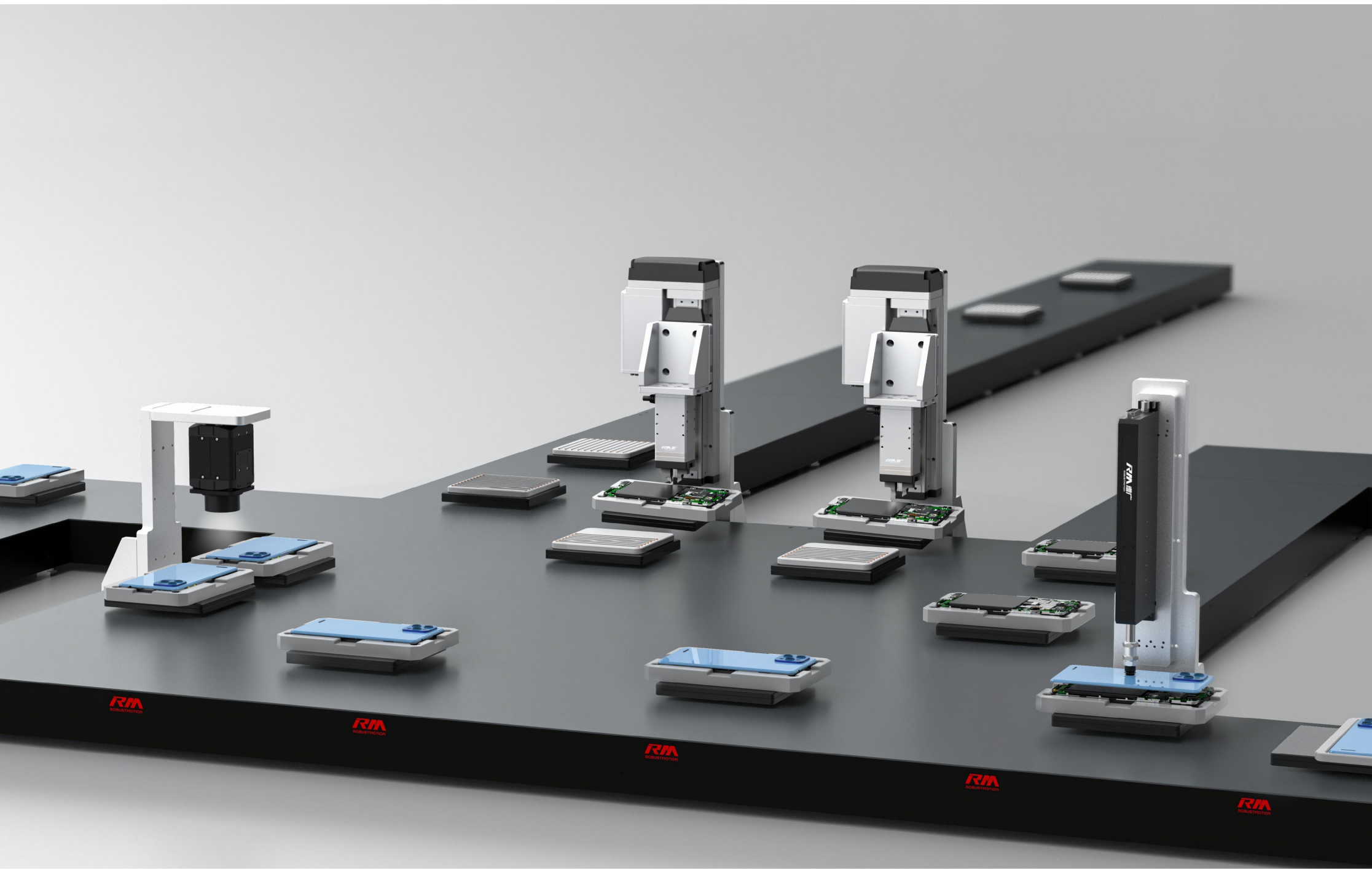
What Actually Changes on the Production Floor
1. Software-Defined Routing Eliminates Mechanical Changeover
In a track-based system, changing the product flow path means moving physical infrastructure. In a planar maglev system, it means updating motion profiles in software.
Each mover on the MagiFloater platform is independently addressable and can follow any path across the stator surface. There is no fixed route, no predetermined sequence, no mechanical constraint on where a product carrier can go. The path from dispensing to inspection to labeling isn't built into the hardware — it's a parameter.
What this means in practice: A multi-SKU fragrance filling line that previously required guide changes and station reconfiguration during product changeover can now switch recipes purely through control software. The same physical platform handles every variant. Changeover time drops from hours to minutes. Floor space utilization improves because you're no longer over-provisioning parallel paths for each product family.
2. Zero-Contact Operation Solves the Contamination Problem at Its Source
The mover never touches the stator. There are no rolling elements, no sliding contacts, no wear surfaces, and critically — no lubricants. The entire transport surface is inherently cleanroom-compatible.
This isn't a marginal improvement in particle generation. It's an architectural elimination of the contamination source. In pharmaceutical and biomedical manufacturing, where ISO Class 5 (or better) environments are standard operating requirements, this distinction isn't academic — it's the difference between a routine environmental monitoring excursion and a non-conformance investigation.
What this means in practice: A vaccine vial filling line using MagiFloater movers as carriers eliminates all transport-related particle generation. There are no belt fragments, no guide wear particles, no bearing grease residues. Environmental monitoring data improves. Investigational overhead decreases. And the CIP (Clean-In-Place) protocol simplifies dramatically because the stator surface is a flat plate with no moving parts to disassemble.
3. In-Situ Process Integration: The Mover Becomes the Fixture
This is where planar maglev fundamentally diverges from every conveyance technology that came before.
Because each mover provides six degrees of freedom with precise, software-controlled motion, it doesn't just transport the product — it can participate in the process. The mover itself becomes a programmable fixture, rotary stage, tilt table, and inspection platform.
How It Works on a Live Line — Right Now
Fragrance & Cosmetics: In-Situ Vortex Blending
At a dispensing station, as different fragrance concentrates are injected into a container, the MagiFloater mover performs continuous, high-speed rotation — creating a controlled vortex directly inside the container.
The result? Perfect homogenization happens simultaneously with filling. No separate mixing step. No intermediate transfer to a blending vessel. No contamination risk from shared agitators.
Each mover carries a single container. Each container can receive a unique recipe. The mover rotates at precisely controlled speed and duration for that specific formulation. Then it translates to the next station — capping, labeling, inspection — on the same platform, with no transfer.
In a facility running 50+ fragrance SKUs in short batches, this capability collapses what was previously a multi-station process (fill → transfer → mix → transfer → cap) into a continuous single-platform operation. The equipment footprint shrinks. The contamination surface area shrinks. The batch changeover logic becomes a recipe parameter.
Nutraceuticals & Supplements: Consistency Without Agitation Damage
Liquid nutraceutical filling presents a specific engineering challenge: active ingredients in suspension tend to settle during processing, but excessive mechanical agitation can degrade sensitive compounds. The traditional solution — slow paddle stirring or recirculation pumps — introduces shear, heat, and additional contamination surfaces.
A MagiFloater mover carrying a supplement bottle through a filling station can maintain a gentle, continuous rotation at precisely the speed needed to keep suspensions homogeneous — no more, no less. The rotation is controlled by electromagnetic field, not a mechanical stirrer. There's no shaft seal to validate, no bearing to clean, no impeller surface to inspect for biofilm.
Food & Beverage: Natural Products Without Compromise
There's a growing market trend toward clean-label products — formulations without synthetic stabilizers or emulsifiers. The engineering consequence is significant: natural products settle. Juices with pulp. Beverages with botanical infusions. Sauces with particulate matter.
On a conventional filling line, you either accept settling (and the consistency complaints that follow), or you add high-shear mixers (and the energy input, foam generation, and cleaning burden that come with them). Neither option is ideal.
A planar maglev carrier can maintain controlled agitation during the filling operation itself — the mover tilts slightly and rotates to keep particulates in suspension while the headspace fills. No separate mixing tank. No high-shear pump. No foam generator. The product stays homogeneous from first fill to last, with zero added process equipment.
Pharmaceutical & Lab Automation: Sterile Rotation Without Mechanisms
In sterile pharmaceutical manufacturing, every mechanical component that contacts or even approaches the product zone is a contamination vector. Gowning requirements, smoke studies, media fill validations — the regulatory overhead is proportional to the number of mechanical interventions in the critical zone.
Traditional approaches to in-process mixing in a sterile environment require laminar-flow isolators, sterilizable-in-place agitators, and extensive validation. Each agitator is a potential failure point. Each seal is a potential breach. Each shaft penetration through the isolator wall is a potential contamination pathway.
A MagiFloater mover approaching a dispensing nozzle from below — rotating a vial under a laminar flow hood — introduces zero mechanical penetrations into the sterile zone. The mover is the stirrer. The transport surface is the bearing. There's nothing to sterilize because nothing contacts anything.
For lab automation — particularly high-throughput screening environments — the same principle applies at micro scale. Movers can position microtiter plates, rotate them for reagent mixing, tilt them for gravity-assisted liquid handling, and translate them between dispensing, incubation, and readout stations — all on a single surface, with no pick-and-place robots required.
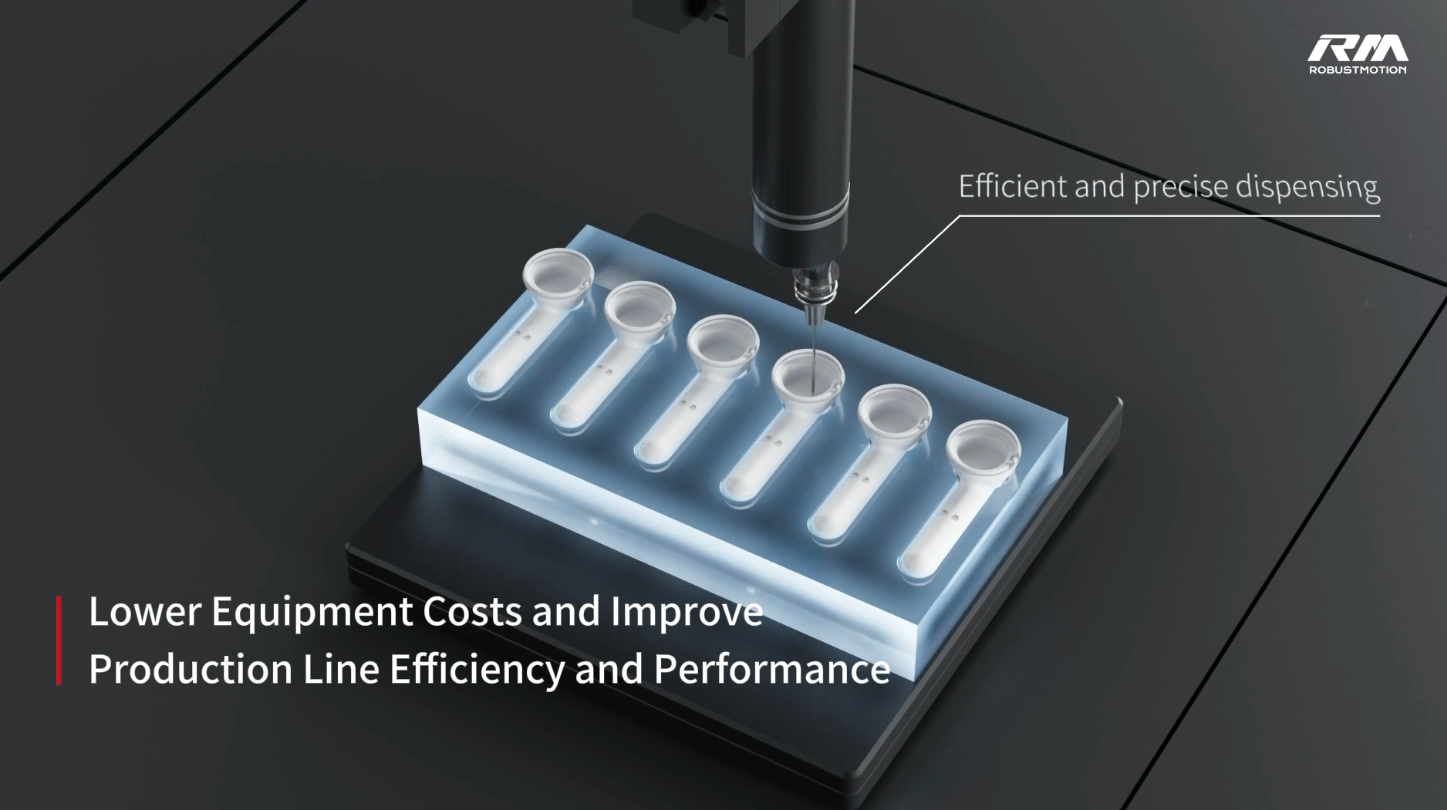
The Engineering Architecture Under the Hood
For control engineers evaluating the platform, the relevant questions go beyond the motion specifications. Here's what matters architecturally:
Stator modularity and scalability. Each 262 × 262 mm tile is a self-contained electromagnetic module with integrated power electronics and communication hardware. Tiles connect via Ethernet and can be assembled into surfaces of any size or shape — including configurations that route around existing equipment, columns, or facility obstacles.
Independent mover control. Each mover is fully independent. The system controller — communicating via EtherCAT, PROFINET, EtherNet/IP, or POWERLINK — can simultaneously coordinate dozens of movers with different motion profiles, speeds, and process parameters.
Precision force control. The MagiFloater control stack provides real-time force sensing with ±0.01 N accuracy, enabling contact-sensitive operations: controlled-force assembly, compliance during mating operations, and process-adaptive force profiles that respond to real-time conditions — all without external force sensors.
A microsecond-level control loop. The proprietary communication and control architecture achieves microsecond-scale loop time across the entire stator-mover network. For multi-mover collision avoidance, synchronized process operations, and high-dynamics trajectory planning, this bandwidth is critical.
When Planar Maglev Is the Right Answer
Planar magnetic levitation is not a universal replacement for every conveyance application. Let's be precise about where the technology creates decisive value and where conventional approaches remain appropriate.
Strong-Fit Applications:
- Regulated environments (pharma, biotech, medical devices) where contamination elimination has direct regulatory and financial impact
- High-mix / low-volume production where changeover frequency makes mechanical reconfiguration economically unsustainable
- Process-integrated transport where the carrier needs to actively participate in operations (mixing, orientation, force-sensitive assembly)
- Cleanroom manufacturing (semiconductor, optics, precision electronics) where particle generation from mechanical contact is intolerable
- Compact footprint requirements where the elimination of separate fixtures, rotary stages, and transfer mechanisms saves critical floor space
Applications Where Conventional Systems May Prevail:
- Very high-speed bulk material handling where sheer throughput velocity outweighs precision and flexibility requirements
- Applications where the process path is truly fixed and never changes — the flexibility premium isn't justified
- Ultra-high-load scenarios (automotive body panels, heavy subassemblies) where linear magnetic track systems or traditional conveyors remain the pragmatic choice
The Bottom Line
Here's the unvarnished engineering calculus:
Every mechanically-contact conveyance system you install carries three hidden costs: maintenance burden (scheduled and unscheduled), contamination management (environmental monitoring, cleaning protocols, investigation overhead), and changeover penalty (mechanical redesign, fabrication, installation, validation time for every product or process change).
Planar magnetic levitation doesn't reduce these costs incrementally — it eliminates the mechanisms that generate them. No contact means no wear. No wear means no particle generation. No mechanical guides means no path constraints. No path constraints means software-defined changeover.
For a pharmaceutical filling line running 200+ days/year in a classified environment, the ROI equation is straightforward: reduced environmental monitoring excursions, simplified cleaning validation, faster batch changeovers, and smaller equipment footprint. The technology premium pays for itself in regulatory simplicity and operational flexibility.
For a high-mix consumer goods facility where SKU proliferation drives constant line reconfiguration, the value proposition is equally direct: what was previously a multi-week mechanical changeover becomes a software update. The line that was "optimized for product A and tolerably adapted for product B" becomes a genuinely flexible platform.
And for process engineers designing next-generation filling, assembly, and inspection operations — particularly where the carrier needs to do more than just move — the MagiFloater platform opens design spaces that simply don't exist with conventional conveyance. When your fixture is also your conveyor, your conveyor is also your rotary stage, and your rotary stage is also your inspection platform, the traditional boundaries between transport and process dissolve.
The question is no longer whether planar magnetic levitation will become a standard tool in the precision manufacturing engineer's toolkit. It's where it creates enough value to be the obvious choice today.
Explore MagiFloater® on your line
See MagiFloater® product options and integration paths, pair with SoftForce®-class precision where your process needs it, or contact our team for layout and application review.