Cleanroom-Compatible Actuation: Why Electric Systems Are Replacing Pneumatics in Precision Manufacturing Environments
Contamination control, process consistency, and lifecycle economics in clean manufacturing automation
The Hidden Contamination Cost of Compressed Air
In precision manufacturing environments, from pharmaceutical packaging lines to medical device assembly cells, contamination control has evolved from a quality consideration to a regulatory mandate. A single airborne particle or oil vapor deposit on a sterile medical component can trigger batch recalls costing millions in lost revenue and regulatory penalties.
Yet despite rigorous environmental controls such as HEPA filtration, positive-pressure enclosures, and strict gowning protocols, a persistent contamination source has remained largely overlooked: the pneumatic actuators that still dominate the majority of automated handling and assembly operations.
The shift from pneumatic to electric actuation in clean manufacturing environments represents more than an equipment refresh cycle. It reflects a fundamental reassessment of how motion control architecture intersects with contamination physics, process consistency, and the total cost of precision production.
The Pneumatic Legacy and Its Hidden Liabilities
Pneumatic systems have been the workhorse of industrial automation for over a century, and their ubiquity in manufacturing is no historical accident. Compressed air delivers high force density, rapid cycle times, and mechanical simplicity, making it the default choice for gripping, pressing, and positioning operations. In food packaging, pharmaceutical filling, and electronics assembly, pneumatics have provided the speed and robustness that mass production demands.
However, the very characteristics that make pneumatics appealing create a systematic contamination burden. Compressed air systems, by design, introduce external atmosphere into controlled environments. Even with point-of-use filtration, pneumatic exhaust can carry atomized compressor lubricants, particulate matter from distribution network degradation, and moisture that compromises sterile conditions or affects adhesive bonding chemistry.
| Pneumatic Risk Source | Impact in Clean Manufacturing |
|---|---|
| Exhaust plume | Creates localized turbulence and contamination zones near the workpiece |
| Lubricant aerosol | Deposits molecular films on products, packaging materials, and optical inspection systems |
| Distribution network wear | Introduces particles from tubing, fittings, and aging infrastructure |
| Moisture carryover | Compromises sterile conditions and affects adhesive or packaging chemistry |
More fundamentally, pneumatic actuators require lubrication to maintain seal integrity and prevent stick-slip behavior that causes positioning inconsistency. These petroleum-based or synthetic hydrocarbons can volatilize into the production environment. In regulated industries, this molecular contamination represents a compliance risk distinct from particulate contamination, yet pneumatic infrastructure remains a primary generator of both.
The Electric Alternative: A Different Physics
Electric actuation replaces the fluid-based power transmission of pneumatics with electromagnetic force generation. Rather than compressing air, channeling it through valves and tubing, and converting fluid pressure into mechanical motion, electric systems transform electrical energy directly into controlled mechanical force through motor-driven mechanisms.
This architectural difference has immediate implications for clean manufacturing. The elimination of compressed air infrastructure removes entire categories of contamination sources. There are no exhaust plumes venting into production zones, no lubricant aerosols transported by air streams, and no moisture introduced from compressor operation. Force is generated through electromagnetic fields acting on mechanical elements, with no fluid medium interacting with the controlled environment.
The sealed construction of modern electric actuators further isolates the production environment from internal mechanical wear. Advanced units integrate non-contact position sensing and sealed bearing systems, eliminating the sliding contacts and exposed lubrication points that can generate particulate debris. The result is a motion system that performs work without introducing the wear products and fluid contaminants inherent to pneumatic systems.
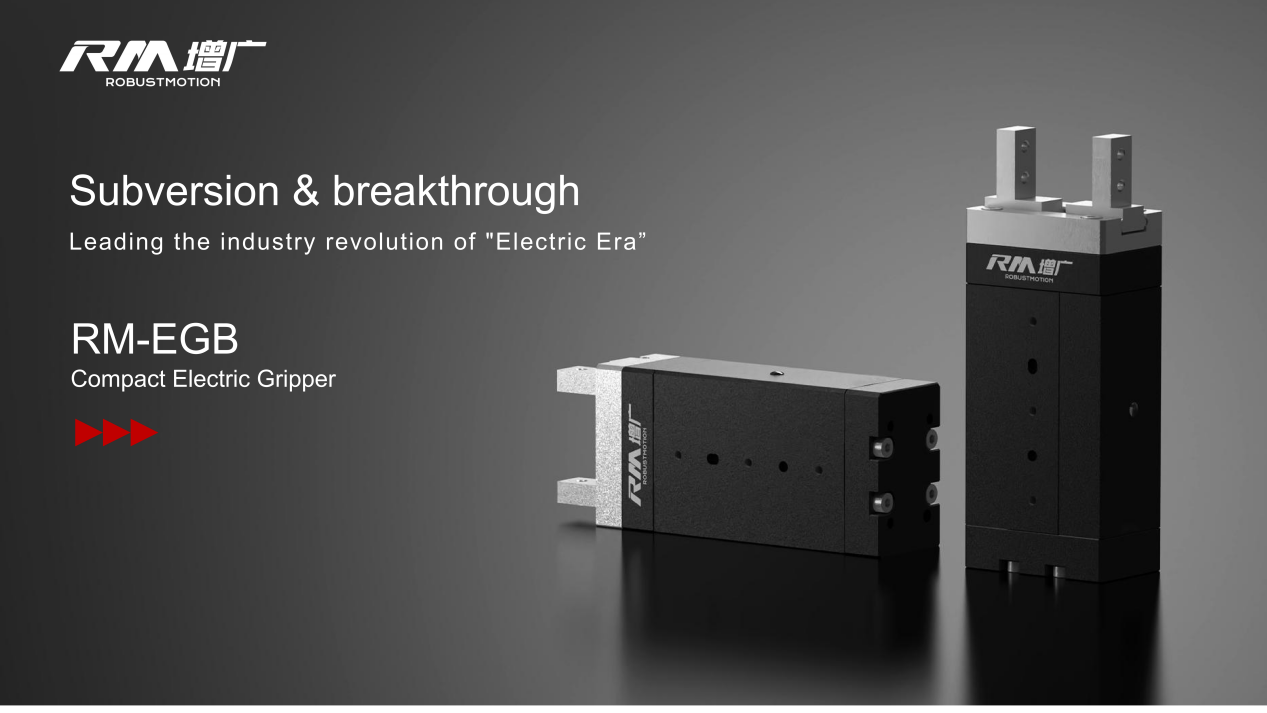
RM-EGB Compact Electric Gripper
- Size & weight: Ultra-compact credit-card size; weighs only 220g.
- Speed: 0.1s maximum opening and closing time.
- Force: 10-80N output.
- Precision: ±0.02mm repeatability.
- Control: Single-cable plug-and-play; supports I/O and Modbus RTU.
Contamination Control Through System Design
The contamination advantages of electric systems operate across multiple physical mechanisms. Particulate generation is confined to minimal levels associated with precision guidance surfaces, typically sealed mechanical bearings or specialized low-friction coatings that require no external lubrication. Molecular contamination is inherently constrained because electromagnetic actuation requires no hydrocarbon-based working fluids in the force path.
The elimination of pneumatic exhaust has cascading benefits for environmental control. Manufacturing facilities maintain carefully balanced air pressure differentials and laminar flow patterns to prevent contaminant ingress. Pneumatic actuators disrupt this balance by introducing unregulated exhaust flows that create turbulent zones and compromise containment. Electric systems, with no exhaust stream, preserve the integrity of engineered airflow designs.
Thermal management also favors electric architectures in controlled environments. Pneumatic actuators generate significant cooling at the exhaust point due to adiabatic expansion, creating localized temperature gradients that disrupt air stratification and can induce convective particle migration. Electric systems generate predictable resistive heat in motor windings, which can be managed through conduction to machine structures rather than convective interaction with process air.
Process Consistency and Quality Economics
Precision manufacturing operates at tolerances where mechanical variability directly translates to quality defects. In medical device assembly, pharmaceutical packaging, and precision electronics, positioning repeatability and force consistency determine whether products meet specification or enter rework or scrap streams.
Pneumatic actuators exhibit inherent variability driven by supply pressure fluctuations, ambient temperature effects on air density, and seal friction that changes with wear state and actuator orientation. The compressibility of air introduces compliance that complicates precision force control, particularly in applications requiring controlled contact forces during delicate handling or assembly pressing operations.
Electric systems offer deterministic behavior. Force output correlates directly to electrical current with minimal hysteresis, and the absence of a compressible working fluid eliminates the positional uncertainty that plagues pneumatic positioning. Force resolution reaches sub-Newton levels with response bandwidths capable of detecting and reacting to contact events in milliseconds, which is essential for preventing damage to fragile components or ensuring consistent assembly pressures.
| Quality Requirement | Pneumatic Limitation | Electric System Value |
|---|---|---|
| Force consistency | Actual force varies with pressure, friction, and seal condition | Digital force setting with closed-loop control |
| Position repeatability | Air compressibility and stick-slip behavior add uncertainty | Encoder-based position control and repeatable motion profiles |
| Validation evidence | Limited feedback beyond open and close states | Process data supports SPC and traceability |
| Changeover speed | Requires pressure, valve, or mechanical adjustment | Force and position parameters can be programmed digitally |
This consistency translates directly to quality economics. In medical device manufacturing, where FDA validation requires demonstrated process control, the repeatability of electric gripping and pressing operations reduces validation burden and supports statistical process control requirements. In high-mix, low-volume production environments, the ability to program force and position parameters digitally enables rapid changeover without tooling swaps or recalibration cycles.
Sustainability and Regulatory Alignment
Manufacturing's environmental footprint faces intensifying scrutiny, and pneumatic systems represent a surprisingly inefficient energy sink. Compressed air generation consumes approximately 10% of global industrial electricity, with overall conversion efficiency from electrical input to mechanical output typically below 20%. Much of this energy is lost to heat, leakage, and the thermodynamic inefficiency of air compression itself.
Regulatory frameworks increasingly reflect this reality. The European Union's Ecodesign for Sustainable Products Regulation and similar initiatives in North American and Asian manufacturing centers prioritize energy efficiency in production equipment standards. Electric actuation, bypassing the compressed air intermediary entirely, offers a direct path to reduced energy consumption and associated carbon emissions.
The transition away from pneumatic lubricants also aligns with tightening chemical regulations. Petroleum-based and synthetic lubricants face increasing restrictions under REACH, TSCA, and comparable chemical safety frameworks. Electric architectures eliminate this compliance exposure by removing lubricated pneumatic components from the production environment.
Implementation Realities
Adopting electric actuation involves practical considerations beyond hardware substitution. Pneumatic systems provide inherent compliance and overload protection through pressure relief, characteristics that must be engineered into electric systems through control software and mechanical design. The higher unit cost of precision electric components requires justification through total cost models that incorporate energy savings, reduced maintenance, elimination of compressed air infrastructure, and quality improvements.
Control integration also differs significantly. Electric systems require servo controllers with sufficient bandwidth to exploit the precision capabilities of electromagnetic actuation, along with communication infrastructure for real-time position and force feedback. This contrasts with the binary or proportional valve control typical of pneumatic implementations, which demands less sophisticated control architecture but delivers correspondingly less process information.
Despite these transition complexities, the industry trajectory is clear. Major equipment manufacturers across pharmaceutical packaging, medical device assembly, and precision electronics have progressively adopted electric actuation in handling robots, filling systems, and assembly platforms. The technology has matured from niche applications to production-proven systems with reliability records matching or exceeding pneumatic equivalents.
Conclusion: Rethinking Motion as a Quality System
The displacement of pneumatics by electric systems in precision manufacturing exemplifies a broader operational insight: contamination control, process consistency, and sustainability are not separate optimization objectives, but emergent properties of system architecture choices. The motion control subsystem, traditionally treated as a utility to be specified on force and speed alone, has become a strategic determinant of product quality, regulatory compliance, and operational cost.
For manufacturing engineers and equipment designers, the pneumatic-to-electric decision now extends beyond purchase price to encompass the full lifecycle cost of precision production. In environments where a single contamination event can destroy a validated batch or trigger a regulatory audit, the elimination of contamination vectors at the architectural level represents not incremental improvement but operational necessity.
The controlled manufacturing environment of the future will be electrically actuated, not because pneumatics have ceased to function, but because the consistency, cleanliness, and control demands of modern precision manufacturing have exceeded the fundamental limitations of compressed air.
Evaluating Electric Actuation for Clean Manufacturing?
Share your cleanliness requirements, workpiece conditions, and motion process. RobustMotion can help assess the value of replacing pneumatic actuation with compact electric systems.