In optics manufacturing, the part is the specification. A lens or prism that leaves the line with a hairline scratch, a chip, or a stress mark is not a rework item — it is scrap, full stop. Yet the very act of handling these parts is what threatens them most: pick-and-place grippers close on polished glass surfaces with a force that, in a conventional pneumatic or current-controlled gripper, is set by guesswork and a regulator knob.
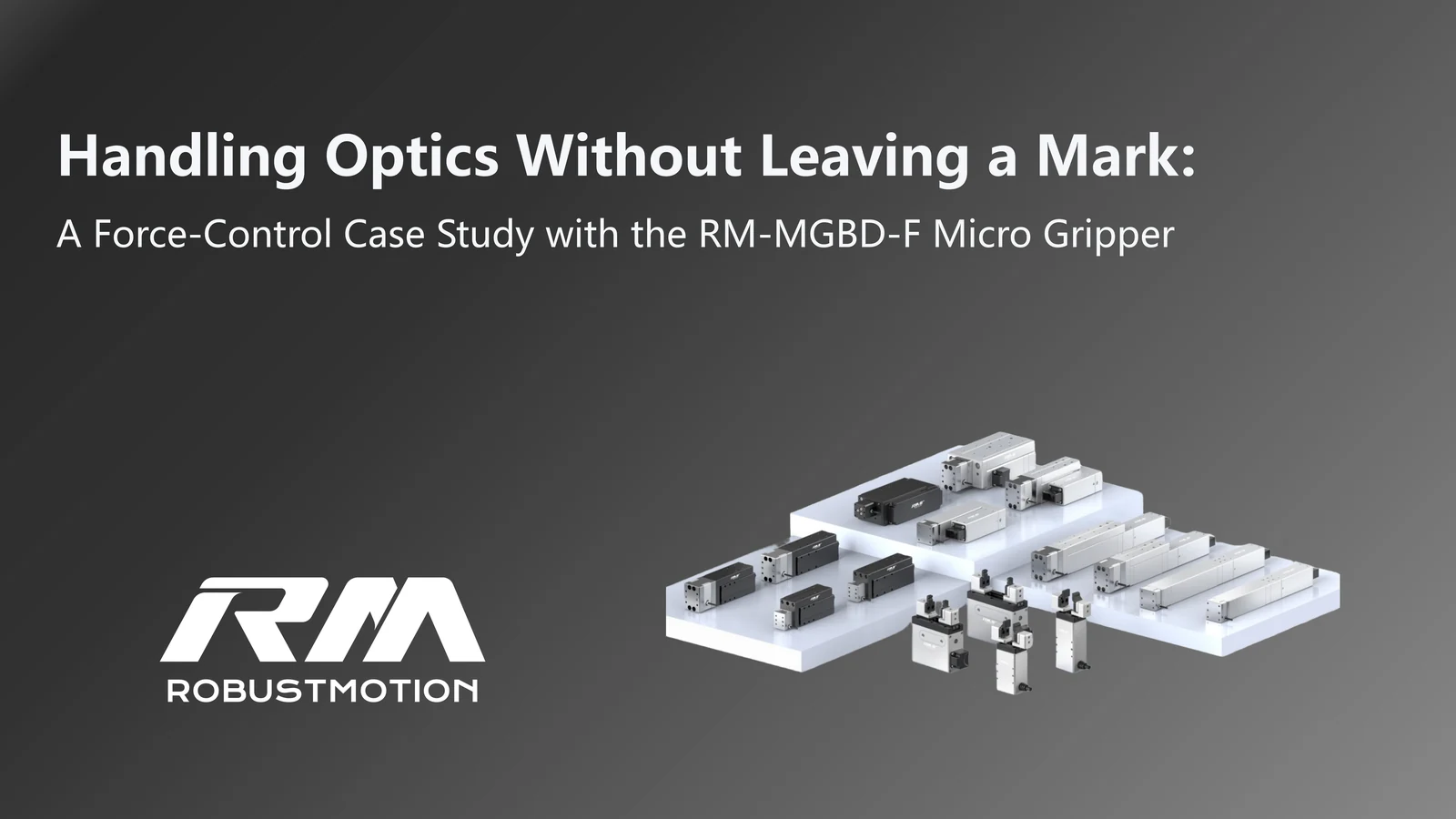
Two production cases show a different approach — force-controlled micro-gripping with the RM-MGBD-F, a SoftForce® precision force-control gripper.
Case one: automotive camera lenses, every size in the tray
A large optics manufacturer transfers micro camera lenses on a single line. The lenses are small — diameters from roughly 17.8 to 21 mm — and thin, from 0.7 to 4.65 mm. They come in plano-convex, biconvex, concave, and other profiles, and they are not one size: the line runs multiple diameters, mixed.
That last point is where a conventional gripper fails. A fixed-stroke gripper sized for one diameter crushes or drops the next. The usual answer is a different gripper, or a different jaw set, for every size — more tooling, more changeover, more chance of a wrong setting on a fragile part.
The RM-MGBD-F approaches the problem differently. Because it controls force — not just stroke — it closes on each lens with a commanded, measured, repeatable force rather than a fixed travel. One gripper handles the full range of diameters and thicknesses. The force stays gentle and consistent whether the part is a 0.7 mm plano-convex wafer or a 4.65 mm biconvex element. No jaw change, no re-tuning.
Case two: optical prisms into inspection
The same gripper moves optical prisms onto inspection stations and through test processes. Here the concern is the surface and the edge: a prism handled too firmly picks up scratches, chips, or micro-fractures that only show up later — under inspection, or worse, in the customer’s instrument.
A force-controlled gripper holds the part firmly enough to move it and gently enough not to mark it, because the force is measured and held in a closed loop rather than estimated from motor current. The result is fragile workpieces that move through handling without damage — and a gripper that adapts to different diameters and shapes without mechanical changeover.
Why force control is what protects the part
The distinction is architectural. A conventional gripper is a position device: it closes until the jaw reaches its commanded point, and whatever force that produces at the glass surface is a consequence, not a choice. Current-based “force control” refines this by estimating force from motor load — accurate to ±5–15%, and with no real-time correction.
SoftForce® force control measures actual contact force with an integrated high-resolution sensor and corrects it in a 10,000 Hz closed loop, to ±0.01 N, with zero overshoot. The gripper lands soft, reaches its commanded force, and holds it — the difference between “approximately gentle” and “provably gentle,” which on optical surfaces is the difference between shipping and scrap.
One gripper, many parts: the flexibility argument
Force-controlled gripping collapses the usual trade-off between precision and flexibility. Because the gripper adapts to the part through force feedback rather than mechanical stroke, a single unit spans a range of diameters and thicknesses that would otherwise require a rack of dedicated grippers and jaw sets. For optics lines running mixed product, that means fewer changeovers, fewer tooling variables, and less chance of a mis-set gripper meeting a fragile lens.
The SoftForce series
The RM-MGBD-F is one member of the SoftForce® family of force-controlled electric actuators — micro and standard grippers, linear actuators, and direct-drive systems — all built on the same architecture: an integrated high-resolution sensor, a 10,000 Hz closed loop, and force-velocity decoupling with zero overshoot. The platform has grown out of a decade of production use and more than 500 application scenarios, from precision optics and 3C electronics to semiconductor, automotive, and biomedical assembly.
FAQ
What is the RM-MGBD-F?
A SoftForce® precision force-control micro gripper for fragile and varied small parts — lenses, prisms, and other optical elements handled without damage or tooling changes.
How does force control protect fragile optical parts?
The gripper measures actual contact force and holds it in a 10,000 Hz closed loop to ±0.01 N with zero overshoot — instead of closing to a fixed position or estimating force from motor current (±5–15%).
Why does force-controlled gripping handle many sizes without tooling change?
It adapts to the part through force feedback rather than mechanical stroke, so one gripper covers a range of diameters and thicknesses that would otherwise need dedicated jaw sets.
What accuracy does SoftForce® force control achieve?
±0.01 N, approximately 0.1% of full scale, maintained at 10,000 Hz with zero overshoot.
Which industries use SoftForce® force-controlled actuators?
Precision optics, 3C electronics, semiconductor, automotive electronics, and biomedical assembly — 500+ documented application scenarios.