If you have spent any time on a modern production floor, you have seen the same frustration play out again and again: a delicate component is damaged during assembly, a press-fit operation yields inconsistent results, or a high-speed handling cycle must be slowed to a crawl just to avoid overshoot. The root cause is rarely a lack of sensing—it is a lack of control.
For decades, automation engineers have treated force as a secondary variable. We bolted load cells onto standard servo axes, ran current-loop estimations, and accepted ±5–15% accuracy as “good enough” for most tasks. But as products shrink, tolerances tighten, and cycle-time pressure intensifies, “good enough” has become a liability. The gap between what we can sense and what we can precisely generate is now the single biggest bottleneck in precision assembly.
The Force Control Paradox
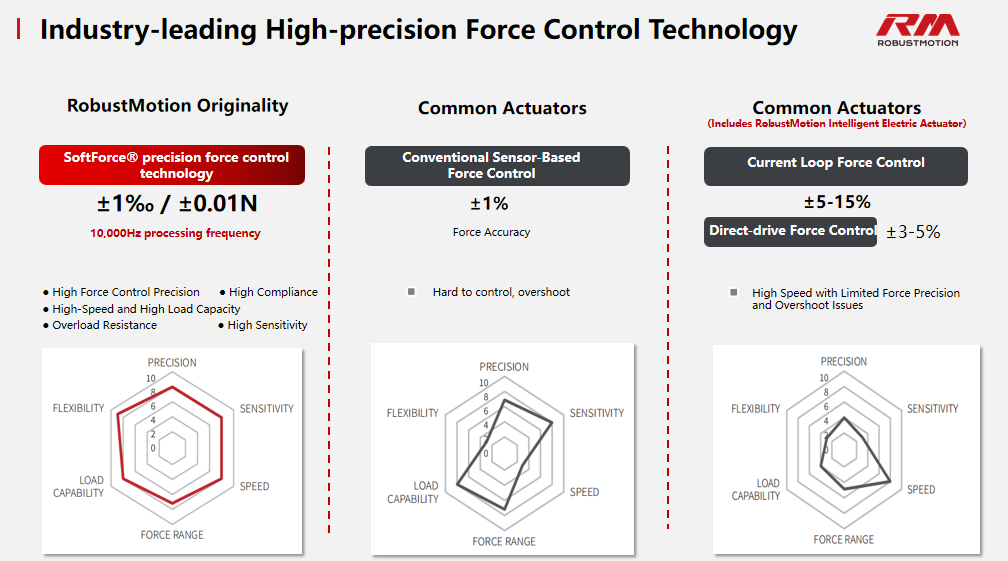
Conventional approaches force us into an uncomfortable trade-off. Current-loop control is fast but coarse, typically delivering ±5–15% force accuracy—fine for clamping, useless for micro-assembly. External sensor closed-loop systems improve this to around ±1%, but mechanical transmission elements (gearboxes, harmonic drives, ball-screw nut backlash) introduce friction dead zones and phase lag. The result? Overshoot, oscillation, and the need to decelerate before contact, directly inflating cycle time.
What the industry needs is not another sensor. It needs an architecture that rethinks force control from the ground up.
Enter SoftForce®: A Fundamental Departure
RobustMotion’s SoftForce® represents exactly that kind of architectural rethink. At its core are three innovations that matter to anyone specifying motion systems today.
- First, 10 kHz closed-loop control. A 0.1 ms cycle time is 50–100× faster than standard robot force-control loops. In practical terms, this means the system detects contact, computes the correction, and stabilizes output before mechanical resonance can even build. You can approach at high speed and execute a true “soft landing” without the tentativeness that kills throughput.
- Second, model predictive control (MPC) rather than traditional PID. Instead of reacting to error after it occurs, SoftForce® continuously simulates the actuator-load interaction and preemptively adjusts motor torque. This decouples speed from precision in a way that conventional systems simply cannot. You no longer choose between aggressive motion profiles and force constraints—you get both.
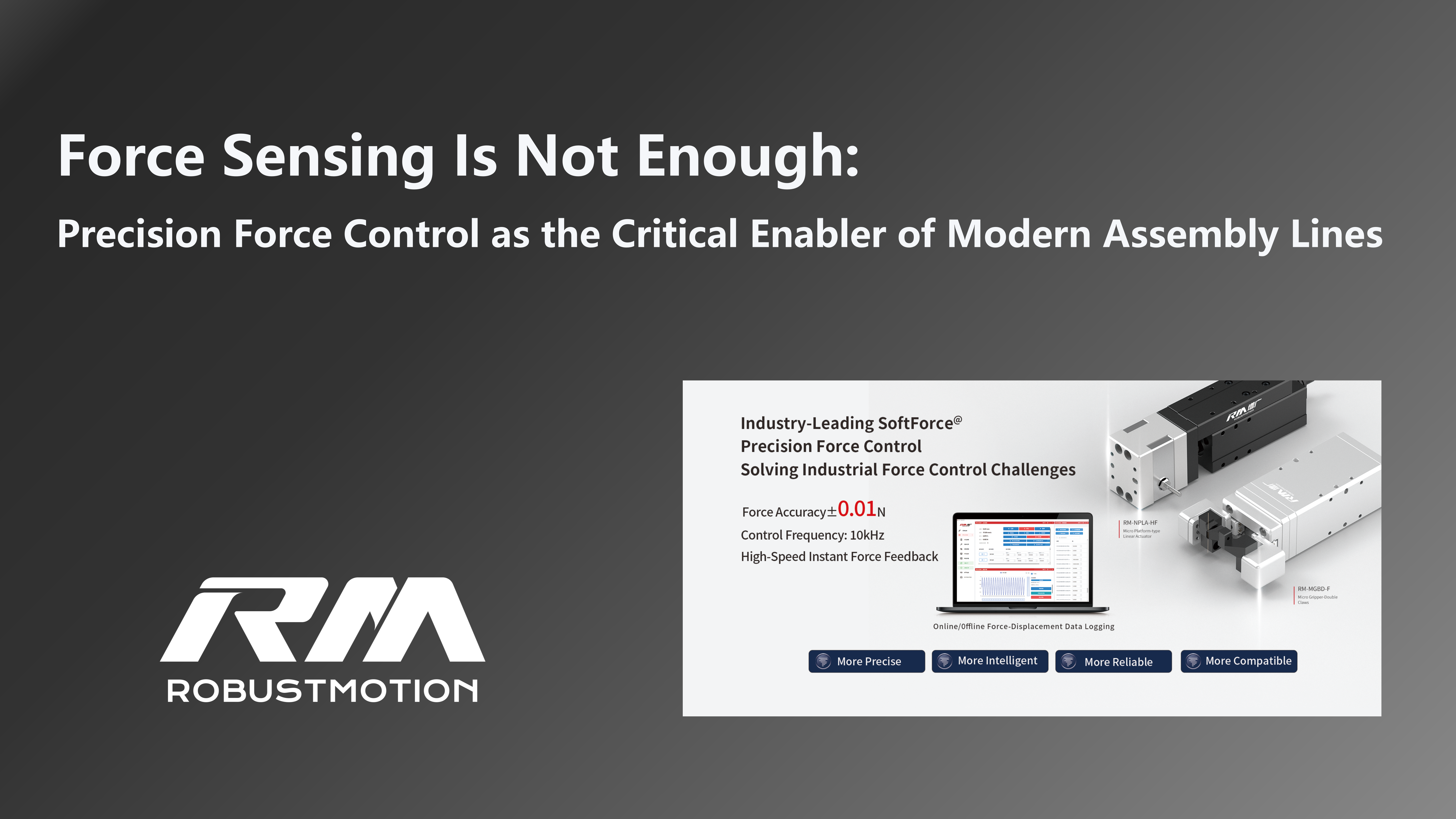
- Third, direct-drive architecture with integrated high-rigidity force sensors. By eliminating gear reducers and co-locating sensing with actuation, the system removes the 0.1–0.5 N friction dead zones that have historically prevented sub-0.1 N precision. The rated accuracy is ±0.01 N (1‰ of full scale), and it holds that accuracy even under high-frequency motion and varying payloads.
Real-World Impact: Where Economics Change
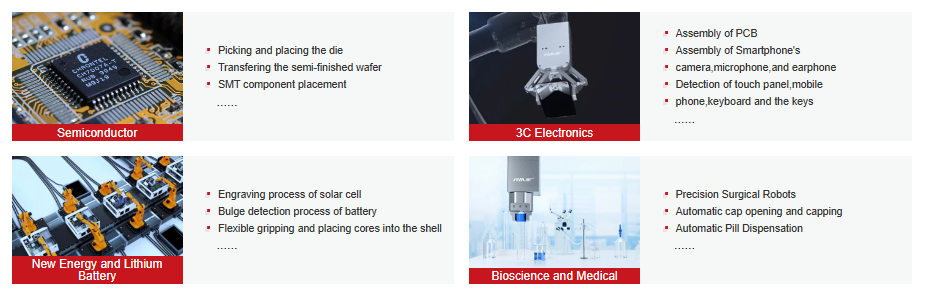
In 3C electronics assembly, pressing smartphone camera lens stacks into housings with <0.01 N tolerance was previously un-automatable. Manual operation introduced variability and ergonomic risk; conventional electric grippers could not hold the tolerance. With SoftForce®, automated assembly achieves >99.5% yield at cycle times competitive with manual operation.
In semiconductor handling, wafer and die gripping forces of 1–5 N with ±0.01 N consistency eliminate the binary risk of dropped parts (>$50,000 losses) versus cracked dies. The system does not merely set force at grip; it actively controls through the entire motion trajectory, compensating for vibration and inertia changes in real time.
In battery production, lithium cell formation and squash testing demand rapid, precise force application. The zero-overshoot characteristic of SoftForce® is not a convenience—it is a safety feature that prevents internal short circuits in pouch cells.
A Practical Framework for Specifiers
The following framework offers an objective guide for system integrators and automation engineers evaluating when SoftForce® technology belongs on the bill of materials:
- Force >1 N, tolerance ±0.5 N: Standard servo with current loop is still cost-effective.
- Force <1 N, tolerance ±0.1 N: Marginal territory for conventional sensor-based systems; consider only if you can accept the speed-precision trade-off.
- Force <0.1 N, tolerance ±0.01 N, or high-speed + precision simultaneously: This is where SoftForce® becomes required. No geared architecture can reliably deliver sub-0.1 N precision, and no 100–200 Hz control loop can prevent overshoot at speed.
Force Control as a Strategic Capability
The evolution of industrial force control mirrors machine vision a decade ago: what began as a specialized add-on is becoming a core requirement for competitive manufacturing. As MEMS, microLEDs, and advanced packaging push component sizes downward, and as human-robot collaboration expands, the ability to precisely generate forces—not merely sense them—separates world-class automation from commodity integration.
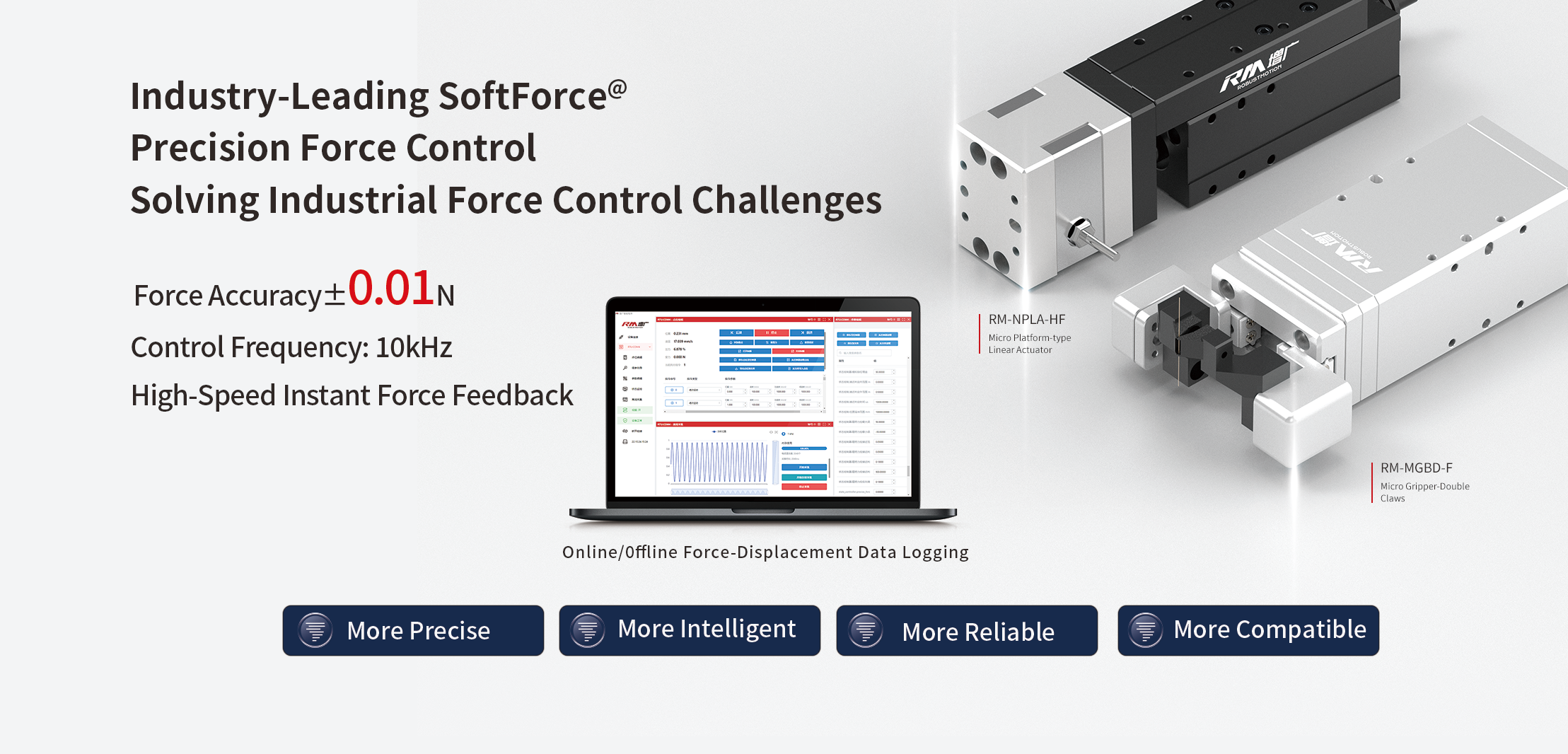
RobustMotion’s SoftForce®, with its 10 kHz control frequency, ±0.01 N precision, and unified mechanical-electrical design, represents the current state of the art in commercially available force control. For those of us designing assembly systems for 2026 and beyond, the question is no longer whether we can afford to specify true precision force control. It is whether we can afford not to.