Beyond Pneumatics: Why Smart Electric Actuators Are Reshaping Modern Production Lines
The Hidden Costs of Conventional Automation: Pain Points Engineers Actually Face
If you've been running automated production lines for any length of time, you've likely encountered these scenarios:
The 3 AM Maintenance Call – A pneumatic gripper failed mid-shift. Again. Your maintenance team is tracing air leaks through a maze of tubing, replacing worn seals, and recalibrating pressure regulators while production sits idle.
The Changeover Nightmare – Your line needs to switch from handling 50mm components to 75mm variants. With pneumatic systems, this means mechanical adjustments, fixture swaps, and hours of downtime. Meanwhile, your competitors with flexible manufacturing systems complete the same changeover in minutes.
The Energy Bill Shock – Your facility's compressed air system is quietly consuming 30-40% of total plant energy. Leaks alone account for 20-30% loss, yet the compressor keeps running 24/7 to maintain line pressure.
The Quality Control Gap – A batch of delicate components arrived damaged. Your pneumatic gripper has two settings: "grip" or "release." There's no middle ground, no force feedback, and no data trail to trace what went wrong.
These aren't isolated incidents. They're systemic limitations of legacy pneumatic architectures that continue to plague modern manufacturing operations.
The Electric Alternative: Not Just an Upgrade, But a Paradigm Shift
Modern electric actuator technology has evolved to address these operational pain points head-on. The latest generation of intelligent electric actuators moves beyond simple "electrification" to deliver smart motion control that transforms how production lines perform.
Infrastructure Reality Check: What You're Really Paying For
A common misconception in actuator selection is fixating on unit cost while ignoring total system economics. Consider the full infrastructure requirements:
| System Component | Pneumatic Setup | Modern Electric Solution |
|---|---|---|
| Core Actuator | Cylinder/Gripper Body | Integrated Electric Actuator (motor + encoder + drive integrated) |
| Required Ancillaries | Solenoid valves, flow controls, position sensors, FRL units, silencers | None – functionality built-in |
| Plant Infrastructure | Air compressor, receiver tank, dryer, filtration, distribution piping | 24V DC power supply only |
| Installation Complexity | Pneumatic tubing + electrical wiring | Single integrated cable (power + communication) |
The Reality: For greenfield installations or standalone workstations, the total installed cost of electric actuation often meets or beats pneumatic alternatives when infrastructure is properly accounted for.
Operational Economics: Where Electric Actuators Deliver Measurable ROI
Energy Efficiency: The 10x Advantage
Compressed air systems operate at approximately 50% energy conversion efficiency (electrical to mechanical), with additional losses from distribution leaks and standby pressurization. Modern electric actuators operate on-demand with direct electrical-to-mechanical conversion.
Real-world impact: Electric actuation typically consumes 1/10th the energy of equivalent pneumatic systems. For a facility running 200 actuators across two shifts, this translates to tens of thousands of dollars in annual energy savings alone.
Maintenance Transformation: From Scheduled to Predictive
Pneumatic systems require regular maintenance: filter element replacements, seal inspections, leak detection protocols, and condensate management. Today's electric actuators are fundamentally maintenance-free under normal operating conditions, with no consumable seals or filtration media to replace.
Performance Capabilities: Enabling Applications Pneumatics Cannot Touch
This is where the discussion moves beyond cost savings to capability enablement. Advanced electric actuator portfolios deliver performance characteristics that open new application possibilities:
Precision Motion Control
| Capability | Pneumatic Limitation | Electric Solution |
|---|---|---|
| Positioning | Binary: extended or retracted only | Any position within stroke range, programmable with repeatability reaching ±0.01mm |
| Velocity Profile | Single-speed via needle valve | Programmable acceleration/deceleration curves for smooth, shock-free motion |
| Force Control | Coarse pressure regulation | Closed-loop force control achieving precision down to ±0.01N for delicate handling |
| Process Feedback | None | Real-time position, velocity, and force data for SPC and traceability |
| Changeover Flexibility | Mechanical adjustment required | Software-parameterized – change grip force, position, and speed in seconds |
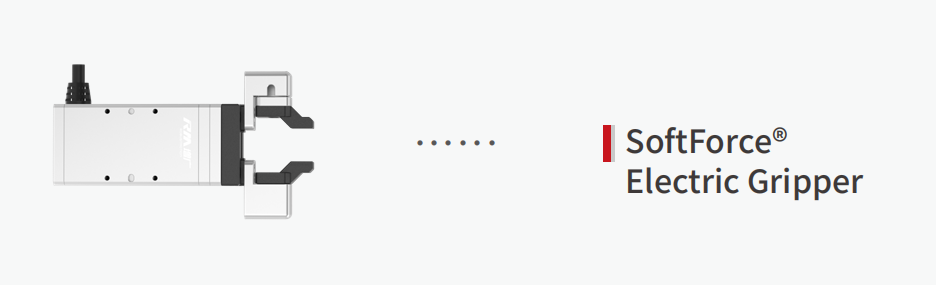
Technical Edge: RobusMotion's proprietary SoftForce® control algorithm achieves force resolution of ±0.01N with 10kHz closed-loop bandwidth—enabling delicate handling of fragile components like glass vials, membrane switches, and populated PCBs that would be impossible with pneumatic systems.
Intelligent Features for Smart Manufacturing
- Adaptive Gripping/Pushing: Automatically adjusts to varying workpiece dimensions without reprogramming
- Drop Detection & Workpiece Confirmation: Integrated sensing eliminates external sensors in many applications
- Process Data Logging: Generate force-time and force-position curves for quality optimization
- Native Industrial Protocol Support: EtherCAT, PROFINET, and other major fieldbuses—no protocol gateways required
- SDK & API Availability: LabVIEW, C#, C++, Python support for custom integration
Technical Edge: RobusMotion actuators support native EtherCAT and PROFINET communication without protocol gateways, and provide comprehensive SDKs with APIs for LabVIEW, C#, C++, and Python—enabling seamless integration into existing automation architectures and custom application development.
The Business Case: When to Choose Electric
Choose Pneumatic If: Your application involves simple two-position actuation, handles a single unvarying workpiece, operates at low cycle rates, and your analysis is limited to unit procurement cost (not TCO).
Choose Electric If:
- Flexible Manufacturing: You need rapid product changeovers without mechanical retooling
- Quality Critical: Process traceability and consistent force/position control directly impact yield
- Energy Conscious: You're targeting sustainability goals or operating in high-energy-cost regions
- Precision Required: Your application involves delicate components, precision assembly, or force-controlled processes
- Data-Driven Operations: You need real-time process feedback for predictive maintenance or quality systems
Conclusion: The TCO Inflection Point
With the introduction of cost-optimized electric actuator series, the historical cost gap between pneumatic and electric actuation has narrowed dramatically. When evaluated on Total Cost of Ownership—incorporating energy, maintenance, downtime, changeover labor, and quality impact—electric actuation delivers superior ROI for the majority of modern manufacturing applications.
The question is no longer whether you can afford to switch to electric actuation. It's whether you can afford not to.