The Changeover Tax: Why Your Flexible Line Isn't as Flexible as You Think
A production engineer's perspective on the hidden cost of tooling transitions in high-mix manufacturing
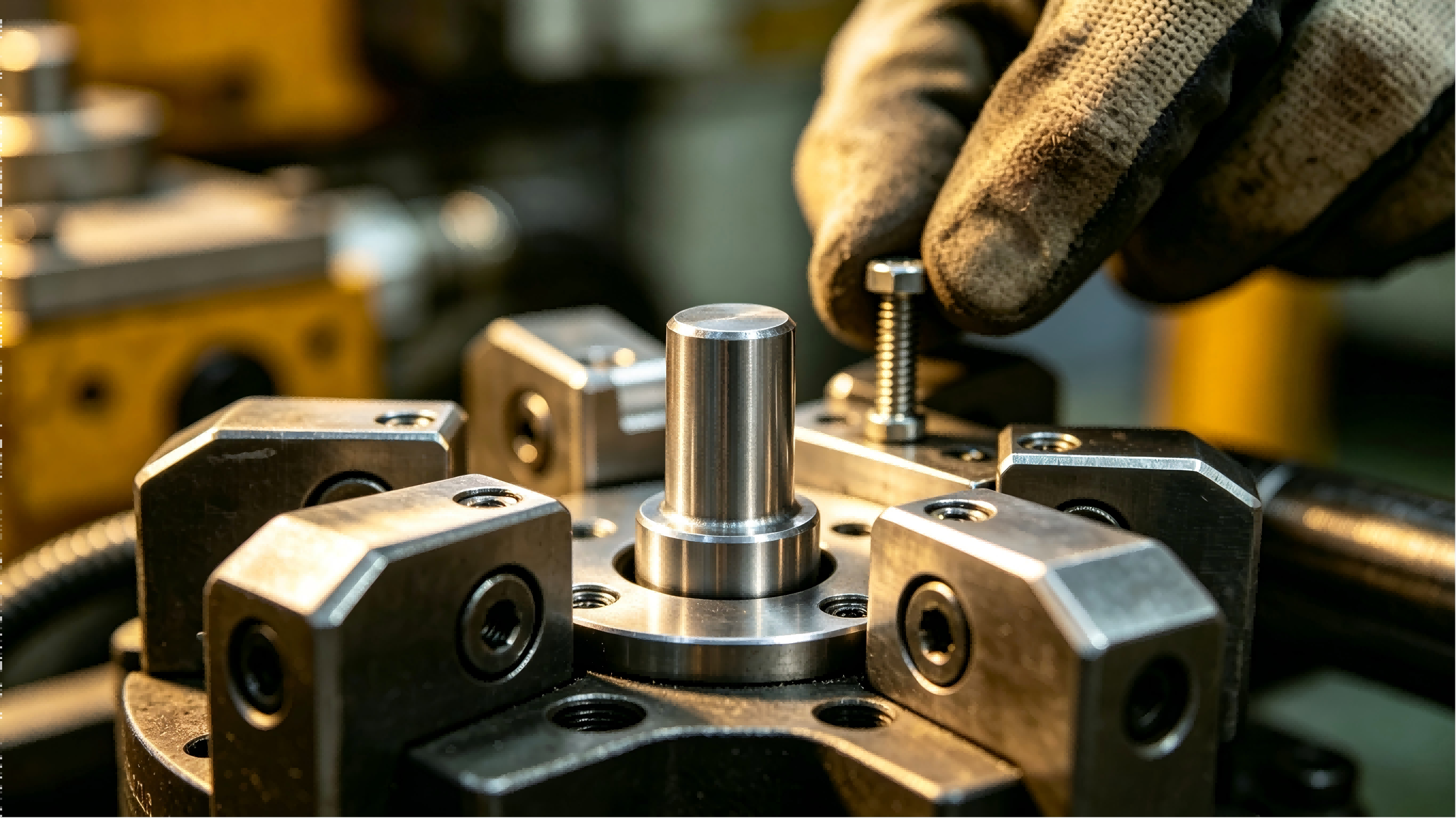
You built the line for flexibility. Twenty product variants, common platform architecture, quick-change tooling. The business case was bulletproof: aggregate demand across variants justifies automation where no single SKU could. Your OEE target was 85%. Your actual utilization hovers around 62%. The gap has a name, and it's not downtime. It's changeover.
Not the catastrophic, line-stopping changeover of dedicated tooling swaps. Something more insidious. The fifteen-minute fixture adjustment that stretches to forty because the locating pin wears inconsistently. The force calibration drift between variants that nobody notices until the quality hold. The subtle accumulation of small variances—finger position, sensor offset, program parameter—that turns each product transition into a mini start-up, consuming engineering attention and eroding the very flexibility the line was designed to deliver.
This is the changeover tax. And in high-mix, low-volume environments, it compounds silently until it exceeds the cost of the product itself.
Where the Flexibility Promise Breaks Down
The fundamental assumption of flexible automation is that hardware commonality plus software configurability equals rapid product changeover. This holds at the macro level. The same robot arm, the same conveyor, the same controller architecture. But the critical interface—the point where the automation system touches the product—remains stubbornly physical, stubbornly variant-specific, and stubbornly resistant to software abstraction.
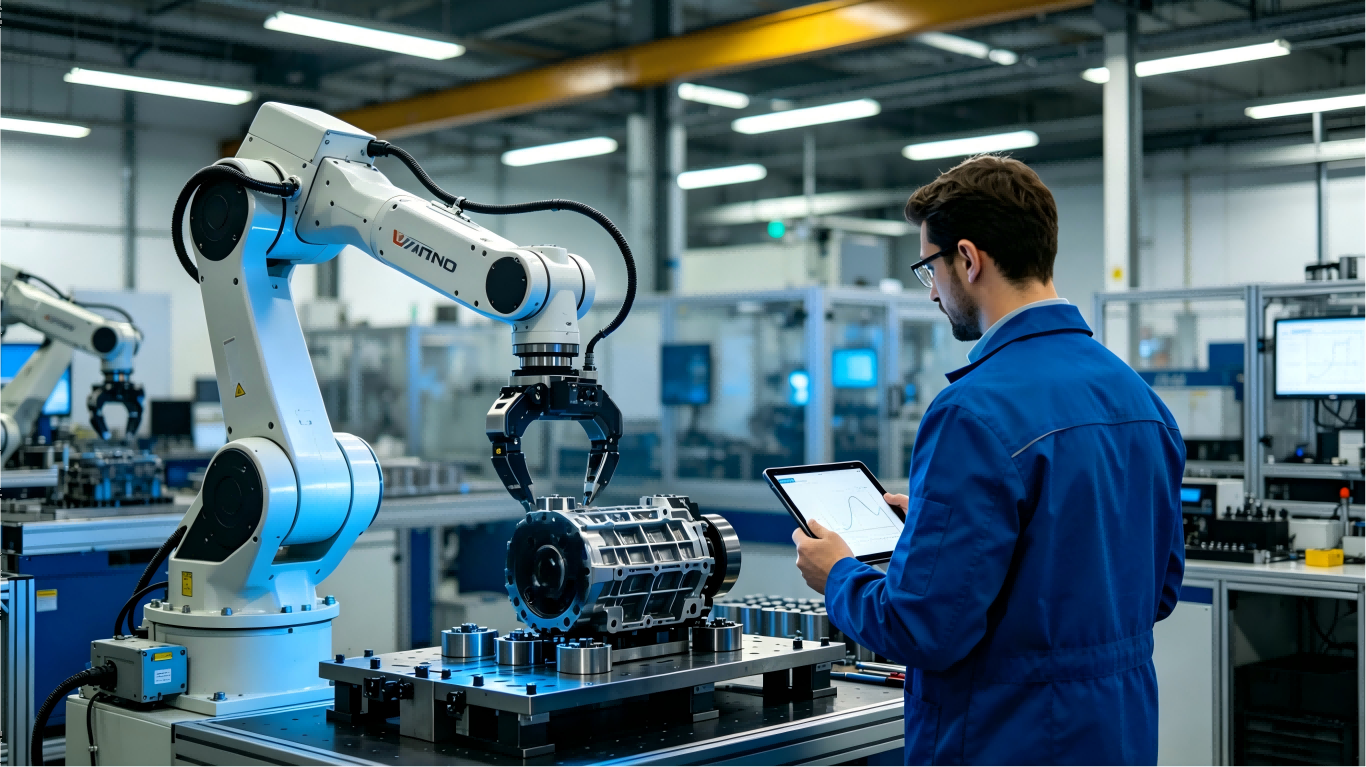
Consider a typical electric gripper changeover sequence. Remove variant-A fingers. Install variant-B fingers. Verify mechanical alignment. Re-teach pick positions. Adjust grip force for the new workpiece mass and surface friction. Validate with first-article inspection. Document parameter set. Release to production.
Each step is individually trivial. Cumulatively, they represent a recurring fixed cost that doesn't scale with batch size. A two-hour changeover amortized across a 10,000-unit run is negligible. Across a 200-unit run, it dominates unit economics. And when your production schedule demands three changeovers per shift, you're no longer running a flexible line. You're running a changeover line with occasional production intervals.
The conventional response—dedicated tooling magazines, automated tool changers, pre-staged parameter sets—addresses the mechanical transition. But it doesn't address the validation burden. Because flexible tooling is only flexible if you trust it, and trust requires evidence.
The Validation Trap
In high-volume, single-product environments, process validation is front-loaded. Weeks of characterization, statistical qualification, regulatory documentation. Then months or years of stable production. In high-mix environments, validation becomes a recurring activity, and the economics shift catastrophically.
Every parameter adjustment carries risk. A grip force optimized for a delicate ceramic substrate may slip on an oily metallic variant. A fast pick speed that works for rigid housings may deform thin-walled components. The engineer's instinct is conservative: qualify more extensively, run smaller batches, build larger safety margins into every parameter.
The result is a creeping paralysis. Changeover time extends not because the mechanical swap is slow, but because the confidence rebuild is slow. Engineers hesitate to release. Quality holds multiply. The schedule buffer inflates. And the line that was purchased for agility becomes the bottleneck that constrains the entire production plan.
The irony is that the automation hardware is often capable of far more adaptability than the process architecture allows. The limitation is not mechanical. It's epistemic. We don't trust the system to know what it doesn't know.
Rethinking Changeover as a Control Problem, Not a Mechanical Problem
The breakthrough insight is that changeover friction is primarily a sensing and intelligence problem, not a hardware problem. If the automation system can perceive the workpiece, understand its own state, and adapt parameters autonomously, the boundary between "changeover" and "production" begins to dissolve.
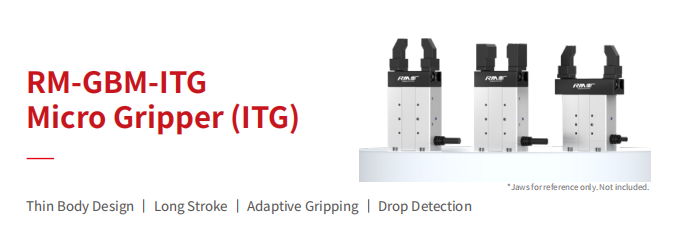
Adaptive gripping illustrates this principle. A gripper with real-time force feedback and sufficient control bandwidth doesn't require pre-programmed force values for each variant. It approaches, senses contact, establishes grip with closed-loop force regulation, and confirms retention through dynamic response. The same hardware handles fragile glass and robust metal, not because it was mechanically reconfigured, but because it was algorithmically aware.
Similarly, automatic dimensional measurement—inner and outer diameter detection, presence verification, positional adaptation—eliminates the teach-and-verify cycle that consumes engineering time. The system measures, adapts, and proceeds without human intervention or judgment.
These capabilities exist today. They are not emerging technologies. They are mature features of advanced electric actuation platforms. Yet they remain underutilized because they challenge the organizational process architecture built around manual changeover validation.
The Software-Defined Changeover
The ultimate expression of this trend is the software-defined production line: hardware that is sufficiently generic and self-aware that product changeover becomes entirely a data transaction. Load recipe. Execute. Validate in-process.
This requires three architectural elements:
- First, actuators with embedded intelligence—force sensing, position feedback, and real-time control loops operating at frequencies where mechanical transients are observable and correctable. Not smart controllers driving dumb actuators, but smart actuators that report state and adapt locally.
- Second, process data infrastructure that captures force-position signatures, correlates them to quality outcomes, and builds the statistical foundation for autonomous parameter adaptation. The line learns what good looks like, variant by variant, and recognizes deviation without explicit programming.
- Third, integration logic that connects the actuator-level intelligence to higher-level manufacturing execution systems. Changeover is not a local event but a system state transition, coordinated across stations, validated against the production schedule, and documented for traceability.
None of this is science fiction. The enabling technologies are deployed in precision manufacturing environments today. The barrier is not technical feasibility but organizational readiness to trust adaptive systems with decisions historically reserved for human judgment.
The Economic Imperative
The business case for eliminating changeover friction is becoming unavoidable. Customer demand fragmentation continues. Batch sizes shrink. Product lifecycles compress. The economics that once justified dedicated lines for high-volume products now demand flexible platforms that can absorb volatility without efficiency collapse.
But flexibility purchased through mechanical complexity—tooling magazines, changeover carts, dedicated setup crews—carries its own overhead. Each physical element adds capital cost, maintenance burden, and failure modes. The alternative is flexibility through intelligence: simpler hardware, richer sensing, smarter control.
The calculation is straightforward. A line with two-hour mechanical changeovers and one-hour validation cycles, running three variants per day, loses nine hours to changeover in a twenty-four-hour operation. Reduce that to thirty minutes through adaptive automation, and you recover six hours of productive capacity. At €400 per hour line cost, that's €2,400 per day. Across 250 production days, €600,000 annually. The investment case for intelligent actuation writes itself.
But the return extends beyond direct utilization. Shorter effective changeover enables smaller batch sizes, which reduces inventory, which improves working capital efficiency. It enables faster response to demand shifts, which improves customer service levels. It reduces the engineering firefighting that consumes technical resources and burns out talent.
The Engineering Challenge Ahead
For the automation engineer designing tomorrow's flexible lines, the design problem is shifting. It is no longer primarily about mechanical range of motion, payload capacity, or positional repeatability. It is about system intelligence: the ability to perceive, adapt, and self-validate in an environment of constant product variation.
This demands a different specification philosophy. Instead of asking "what is the maximum force this gripper can apply," we ask "what is the minimum force it can reliably control, and how quickly can it adapt when the workpiece changes?" Instead of "how fast is the changeover," we ask "what would make changeover unnecessary?"
The answer to that last question is not elimination of product variation. That is a market reality beyond engineering control. The answer is automation systems that absorb variation without human intervention, that treat each workpiece as an individual rather than an instance of a batch, that grip with awareness rather than with pre-programmed assumptions.
The flexible line of the future will not distinguish between production and changeover. It will flow continuously from variant to variant, adapting in real time, validating in process, and trusting its own perception more than the documentation from the last setup.
Getting there requires more than new hardware. It requires a shift in how we design processes, how we validate quality, and how we organize the relationship between human judgment and machine intelligence. But the economic pressure is building, the technology is available, and the engineers who solve this problem will define the next generation of manufacturing competitiveness.
The question is no longer whether your line can handle multiple variants. It is whether it can handle them without stopping to ask for permission.
Quantifying the Changeover Tax on Your Line?
Share your variant mix, current changeover cycle, and validation workflow. RobustMotion can help evaluate where adaptive gripping and intelligent actuation recover lost utilization.