What Is Closed-Loop Force Control?
Closed-loop force control is a control architecture in which the contact force at an actuator’s end-effector is measured in real time by an integrated high-resolution sensor and fed directly into a dedicated high-frequency control loop — so the system continuously corrects its output to hold a target force, the same way a servo loop holds a target position. In an open-loop system, force is merely estimated from motor current; in a closed-loop system, force is measured, compared against the command, and corrected hundreds of times per contact event.
Why does this matter? Every automation engineer has seen the failure modes: the cylinder strokes to end-of-travel and crushes the workpiece; the servo reaches its commanded position and the connector pin buckles. The machine can locate a point to within microns — but it has no idea how hard it is pushing when it gets there. Over the past decade, automation has replicated the human arm (robotics) and the human eye (machine vision). The last dimension still hard to replicate is the human sense of touch: a skilled worker feels the clearance between mating parts, micro-adjusts to find the insertion angle, senses whether a fit is too tight or too loose. Replicating touch in a machine requires more than bolting a sensor onto an actuator — it requires rethinking the control architecture from the ground up.
The Three Architectures of Force Control
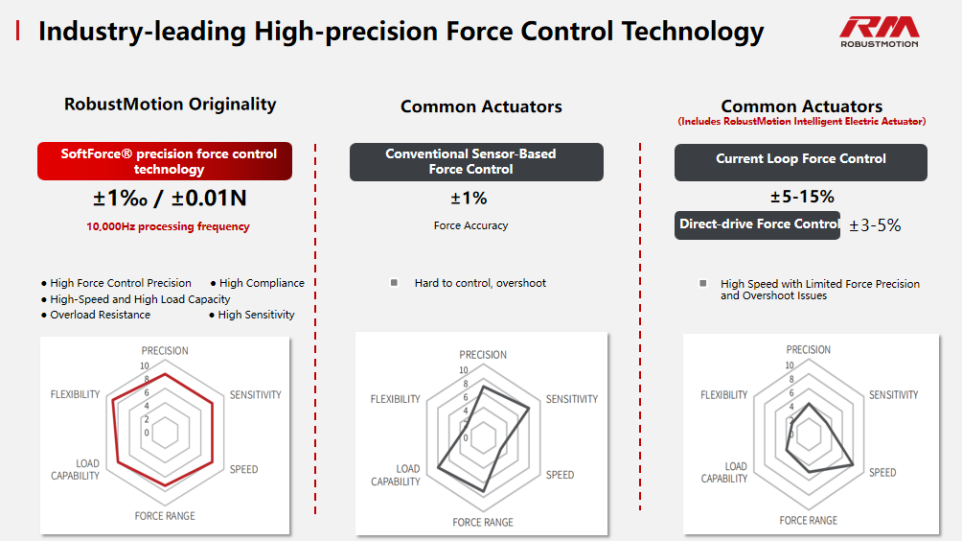
Solutions on the market today fall into three categories — and the differences between them are architectural, not cosmetic.
Category 1 — Current-Loop Actuators (Open-Loop Estimation)
Electric grippers and cylinders that simulate force control by adjusting motor current percentage: more current = more force. There is no force sensing and no feedback loop. Accuracy is ±5–15%, consistency is poor, and the approach suits only applications where force is non-critical.
Category 2 — External Sensor + General-Purpose Controller
A force sensor is added to the actuator, paired with an amplifier and a general-purpose controller — a three-component chain. Force output is more precise, but the architecture was designed for position control first; force signals are treated as a correction layer patched on top. The signal path is long, latency is high (~100 Hz typical), accuracy plateaus around 1%, and high-speed operation is routinely sacrificed to avoid overshoot.
Category 3 — SoftForce®: Force as a First-Class Control Objective
RobustMotion’s SoftForce® platform does not add force control to an existing architecture — it redesigns the control stack with force as a primary target, at the same level as position. A high-resolution sensor is integrated at the end-effector, sampling into a dedicated closed loop running at 10,000 Hz. The result: ±0.01N force accuracy, with zero overshoot even at high speed, and seamless position↔force mode transitions at the instant of contact — the most demanding moment in any force-controlled process.
The Comparison, in Numbers
| Parameter | Current-Loop (Cat. 1) | Sensor + External Controller (Cat. 2) | SoftForce® (Cat. 3) |
|---|---|---|---|
| Force accuracy | ±5–15% | ~1% | ±0.01N (up to 0.1%) |
| Processing frequency | N/A (open loop) | ~100 Hz typical | 10,000 Hz |
| Overshoot at speed | Uncontrolled | Common; speed reduced to compensate | Zero |
| 5,000-cycle repeatability | ±13N variation | Not published | ±0.1N variation |
| Architecture | Position control only | Force as correction layer | Force as first-class objective |
Why Response Speed Determines Everything
The bandwidth of the force loop determines whether an actuator can complete the “contact–sense–adjust” sequence within a production line’s cycle time. Three factors must be deeply coupled:
- Sensor sampling rate — fine enough to detect the transition from free motion to contact.
- Signal path latency — SoftForce® integrates sensor, drive electronics, and control algorithm in a single closed loop, eliminating the multi-component signal chain of Category 2.
- Algorithm sophistication at contact — the transition from position mode to force mode must happen smoothly, without overshoot or oscillation, requiring microsecond-level proprietary algorithms a general-purpose controller cannot deliver.
The Real Dividing Line: Consistency Over Millions of Cycles
In a laboratory, many solutions can produce an impressive force-position curve. On a production line, the question industrial customers actually ask is: can the system hold its force accuracy over millions of cycles — with varying temperature, material batches, and mechanical wear?
Consider connector insertion in 3C electronics: a cycle completes in under one second, requires 0.1–1% force accuracy, and needs dynamic posture adjustment from real-time feedback. If force output drifts after hundreds of cycles, the result is intermittent insertion failures — the kind of fault that is extraordinarily costly to diagnose because it cannot be reproduced on demand.
In validation testing, a SoftForce®-equipped actuator (RM-RPLA-11-50-2-HF100-001) completed 5,000 repetitive force tests with total force variation of only ±0.1N — versus ±13N for a current-loop actuator under identical conditions. SoftForce® achieves this through redundant sensor design and proprietary auto-compensation algorithms.
Practical Impact: Yield and Cycle Time
- First-pass yield: in precision connector insertion, current-loop solutions are not viable; external-controller systems typically stabilize at 90–95%. SoftForce® actuators — adjusting force and posture in real time — consistently exceed 99.5% first-pass yield.
- Cycle time: in one documented application, replacing a conventional servo-press (100 Hz, 6-second cycle) with SoftForce® (10,000 Hz) cut the complete cycle from 6 seconds to 1.5 seconds — 4× throughput, with no trade-off between speed and force stability.
Beyond Control: Every Actuator Becomes a Process Monitor
A 10,000 Hz closed loop generates high-resolution force-position-time data as a byproduct of normal operation. Process engineers can analyze force signatures, compare cycles, and identify drift before it becomes a quality problem — turning every actuator into a monitoring point, with no additional instrumentation.
Proven Across Industries
SoftForce® actuators — electric grippers, linear actuators, direct-drive actuators, and linear-rotary systems — have accumulated 500+ application scenarios across 3C electronics, semiconductor manufacturing, automotive electronics, and biomedical production: precision assembly, flexible gripping, force-controlled insertion, press-fitting, precision tightening, and quality inspection.
For a complementary view on why sensing alone is not enough, see Beyond Force Sensing: Why True Precision Force Control Is the Missing Link in Modern Assembly Lines.
FAQ
Q1: What is the force control accuracy of SoftForce®?
±0.01N — approximately 0.1% of full scale — maintained with zero overshoot at high speed, verified over 5,000-cycle repeatability tests (±0.1N total variation).
Q2: How does closed-loop force control differ from current-loop force control?
Current-loop control estimates force from motor current (open-loop, ±5–15%). Closed-loop control measures actual contact force with an integrated sensor and corrects it in real time at 10,000 Hz — 100× the accuracy.
Q3: Why does force control accuracy matter in automated assembly?
Precision processes like connector insertion or lens handling operate at 0.1–1% force tolerance. Excess force damages components (micro-cracks, buckled pins); insufficient force causes incomplete insertion. Force accuracy directly determines first-pass yield.
Q4: Can SoftForce® maintain accuracy under load and over time?
Yes. Proprietary algorithms compensate for end-of-arm tooling inertia and gravity in real time, and redundant sensing plus auto-compensation holds long-term stability within tolerance across millions of cycles.
Q5: Which industries use SoftForce® force-controlled actuators?
3C electronics, semiconductors, automotive electronics, lithium battery manufacturing, optics, and biomedical production — 500+ documented application scenarios.