How Planar Magnetic Levitation Conveyors Benefit 3C Smart Manufacturing
Why software-defined, contactless transport is becoming a practical platform for high-mix electronics assembly
When Apple’s Chief Operating Officer Sabih Khan recently praised China’s supply chain partners as a source of genuine pride, he was affirming something every seasoned automation engineer already senses: the manufacturing ecosystem behind the world’s most exacting consumer electronics has matured into something world-class. But the more interesting story for those who design production lines is what is happening underneath that supply chain — at the level of the transport technology that moves sub-assemblies between stations. Planar magnetic levitation (maglev) conveyor systems are quietly rewriting assumptions that have governed 3C (computer, communication, consumer electronics) assembly for two decades, and platforms like the MagiFloater® from RobustMotion are at the forefront of this shift.
Image source: “苹果首席运营官萨比·汗:中国的供应链合作伙伴让我们十分自豪” (Apple COO Sabih Khan: China’s supply chain partners make us proud), China Trade News, via WeChat: mp.weixin.qq.com.
The Problem Traditional Lines Were Never Built to Solve
3C manufacturing is defined by volatility. Product lifecycles measured in months, SKU proliferation, and relentless pressure on takt time have pushed high-mix, low-volume (HMLV) production from an exception into the norm. In today’s telecommunications, IoT, and wearable electronics sectors, a typical production batch might be just 50 to 100 units before switching to something completely different — and the next batch may require an entirely different assembly sequence.
Yet the conveyors most lines still rely on were conceived for the opposite world: long runs of a single product, fixed tracks, changeovers measured in days. The moment a traditional line absorbs a new model, the cost appears everywhere — mechanical retooling, recabling, re-teaching of fixtures, and the downtime that accompanies all of it. Planar maglev attacks this at the root by removing the one thing that makes traditional lines inflexible: the track itself.
Contactless Motion, Transmission-Free Design
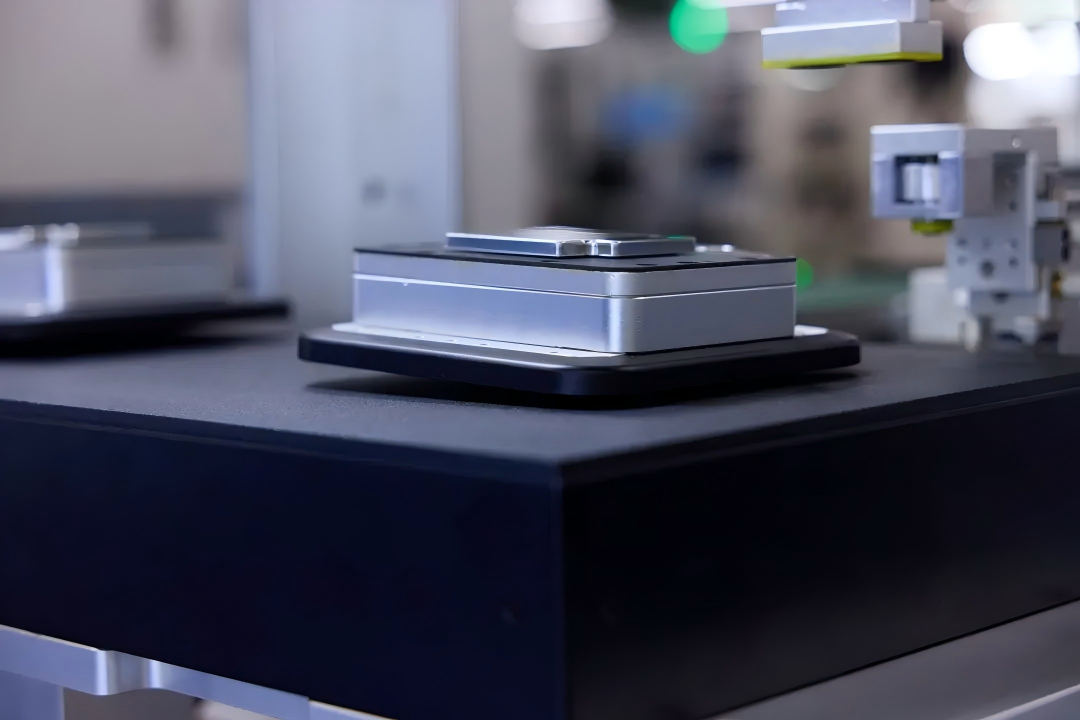
In a planar maglev system, movers levitate above a matrix of stator tiles — there is no belt, no chain, no gear, no contact surface. Movers are entirely passive — no onboard motors, no batteries — which means zero drivetrain wear, no lubricant contamination, and a cleanliness profile suited to the cleanroom-adjacent assembly zones where camera modules, optical components, and semiconductor-adjacent 3C work take place.
This matters concretely in 3C. Camera module manufacturing, for instance, requires dust-free environments where even a single particle trapped inside a lens assembly can degrade image quality. The contactless, particulate-free nature of maglev transport eliminates an entire category of contamination risk that belt-driven conveyors introduce through friction, lubricant migration, and particulate generation. In semiconductor and electronics manufacturing, this ultra-clean, vibration-free movement is increasingly recognized as essential — and the same requirements apply directly to 3C assembly.
Software-Defined Paths Instead of Fixed Geometry
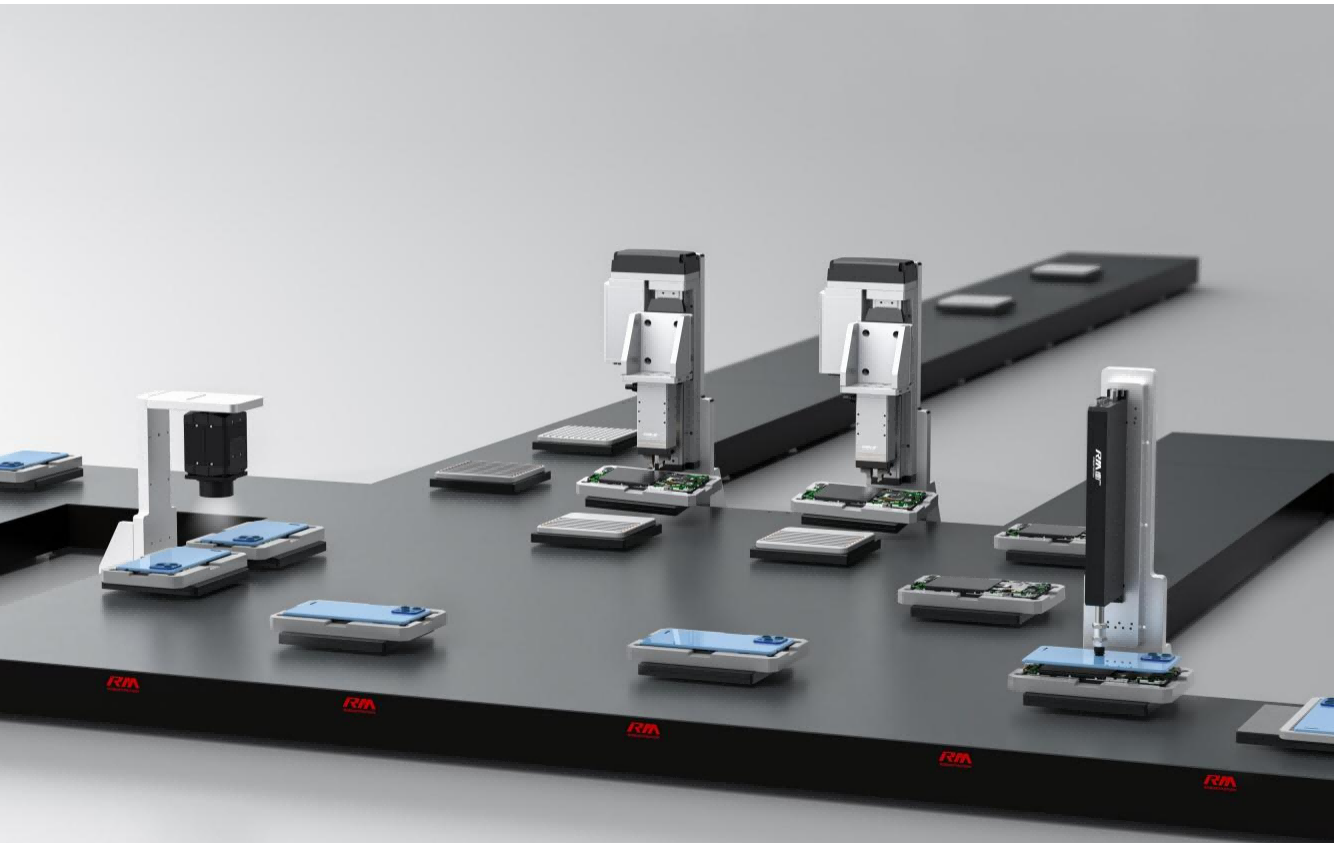
On a conventional line, the route a product takes is a physical fact — steel and aluminum decide it. On a planar maglev system, the route is software. Paths are defined and redefined in the planning environment; a layout can be linear, square, multi-level loop, or a complex vertical topology, all on the same stator matrix. The MagiFloater® platform’s claim of “changeover: days to hours” is not marketing flourish — it is the natural consequence of replacing mechanical reconfiguration with a re-planning exercise.
For 3C lines where a new phone or wearable can reshape the entire assembly sequence every quarter, this alone collapses a category of cost that traditional engineering absorbs as inevitable. System integrators working across manufacturing environments confirm that planar motor maglev conveyors thrive specifically in high-mix, low-volume production lines and flexible assembly environments where future-proofing is key — precisely the 3C profile.
Independent Mover Control and Mixed-Model Flow
Traditional conveyors move everything at the line’s master speed; a slow station throttles the whole line, and a fast one starves. Planar maglev movers are controlled individually — each follows its own dynamically optimized trajectory with six degrees of freedom, including tilt and rotation capability that allows the mover to present the workpiece at the optimal angle for each processing step.
The MagiFloater® system supports synchronous and asynchronous movement simultaneously, with automated overtake and bypass, obstacle avoidance, and smart merge/divert. The practical result is genuine mixed-model production on a single physical line: product A and product B coexist, each routed to the stations it needs, each held back or sped forward as bottlenecks form and clear. The line becomes self-balancing rather than master-paced. With AI-integrated scheduling, algorithms optimize routing, reduce cycle times, and improve throughput — creating an agile production line that adapts to market changes in real time.
A single MagiFloater® controller can orchestrate up to 256 stators simultaneously — supporting complex, multi-zone production layouts without requiring additional controller hardware. This means a full assembly line — loading, dispensing, inspection, press-fitting, testing, and unloading — can run on one coordinated surface, with movers flowing freely between stations.
The Mover as a Processing Platform, Not Just a Carrier
This is perhaps the most underappreciated advantage. Because each MagiFloater® mover provides six degrees of freedom with precise, software-controlled motion, it does not just transport the product — it can participate in the process. The mover itself becomes a programmable fixture, tilt table, and inspection platform. In 3C assembly, this means a single mover carrying a phone sub-assembly can present it to a dispensing nozzle at the optimal angle, then rotate to a vision inspection station, then tilt for press-fitting — all without transferring the workpiece between fixtures.
For camera module active alignment — where a lens must be held in exact position while adhesive is applied and cured — the mover’s ability to provide high-precision positioning while serving as the positioning stage itself eliminates the need for separate alignment fixtures and transfer steps. The traditional boundaries between transport and process dissolve: when your fixture is also your conveyor, and your conveyor is also your inspection platform, the entire production flow compresses.
An Open Ecosystem, Not a Black Box
For Western automation engineers, integration friction is a legitimate concern with any new motion platform — particularly when the leading systems on the market lock users into a single-vendor ecosystem with proprietary controllers and a single communication protocol. The MagiFloater® system was designed from the ground up to be different.
It supports EtherCAT, Ethernet/IP, CC-Link, and PROFINET natively — meaning it drops into whatever PLC and motion-control architecture the facility already runs, rather than forcing the customer to adopt a new control ecosystem. This is especially relevant for 3C manufacturers with multi-vendor factory floors, where a transport system that speaks only one protocol becomes an integration burden rather than an enabler.
Beyond protocol openness, MagiFloater® provides an SDK spanning Python, C#/C++, and JavaScript with comprehensive API and code samples — allowing controls engineers to develop, test, and deploy custom motion logic in the languages they already use, rather than being confined to a proprietary programming environment. Virtual commissioning and simulation, one-click path planning, and algorithm-powered scheduling are built in. The result: 60% faster line deployment — the difference between a system you evaluate and a system you can actually implement on your timeline.
Footprint, CAPEX, and Throughput
The numbers published for the MagiFloater® platform align with broader industry experience: 30–50% footprint reduction, 30–50% inventory cycle reduction, roughly 70% CAPEX reduction versus comparably specified traditional lines, and meaningful throughput increases. The mechanisms are intuitive — simplified overhead mechanics, fewer structural frames, no return loops for belts, and stators that tile into whatever surface area the cell actually has. Throughput gains come not from raw speed alone but from the elimination of the line-balance penalty that dogs every paced conveyor.
Why 3C Is the Natural Fit
The components that define 3C assembly — phone camera modules, wearable PCBs, sensor sub-assemblies, connector modules, battery cells, and display components — are precisely the category that planar maglev handles best. The precision and six-degree-of-freedom control serve alignment-critical steps like dispensing, active alignment, and vision inspection. The open protocol architecture integrates with the multi-vendor control environments common in 3C fabs. And the reconfigurability serves the only constant in 3C: change.
The global magnetically levitated planar motor market — projected to grow from approximately $0.9 billion in 2024 to $2.6 billion by 2033 at a 12.4% CAGR — reflects a broader recognition that contactless, software-defined transport is moving from speculative to standard. For automation engineers evaluating their next 3C line investment, planar maglev is no longer a technology to watch. It is a platform to evaluate — today.
The supply chain Apple’s COO praised is not just assembling better. In systems like this, it is inventing the next layer of how assembly itself is done.
Reference: 张凡. 苹果首席运营官萨比·汗:中国的供应链合作伙伴让我们十分自豪 [J]. 中国贸易报, 2025. Retrieved from https://mp.weixin.qq.com/s/u8m2V8RFMLUWcAW5uiHF5g.
Evaluating Maglev Transport for Your Next 3C Line?
Tell us about your mix, changeover pressure, cleanroom constraints, and station sequence. We can help assess MagiFloater® fit for flexible electronics assembly.