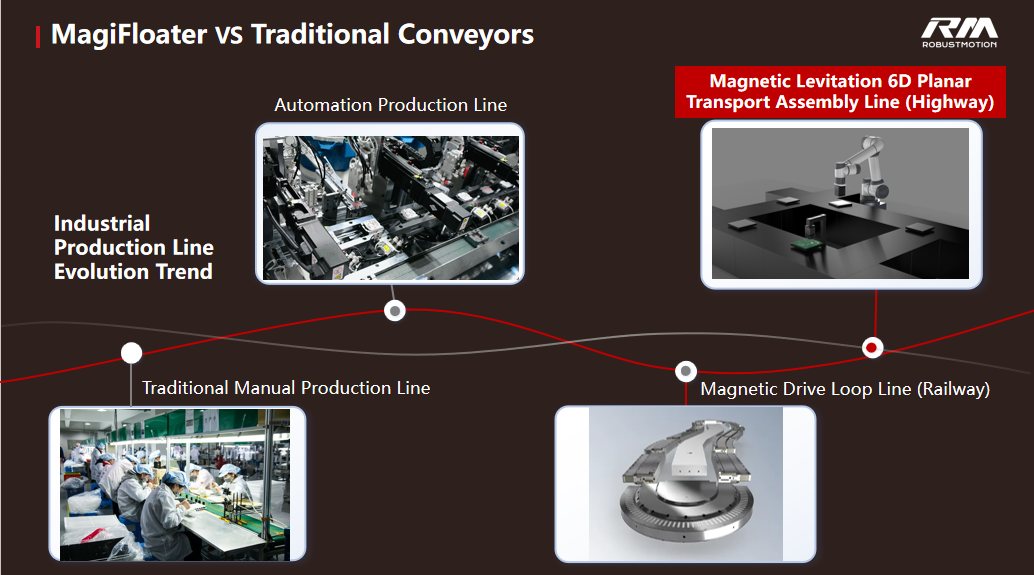
For decades, automation engineers have accepted a fundamental constraint: if you want to move a product through a process, you put it on a conveyor, a pallet-based loop, or a pick-and-place gantry. The path is fixed, the cycle time is dictated by the slowest station, and any motion beyond simple translation requires additional mechanisms—rotary tables, lift stations, or robotic hand-offs. We have optimized around these constraints so thoroughly that we sometimes forget they are constraints at all.
But as lot sizes shrink, product mixes diversify, and cleanroom and precision requirements tighten, the cost of that fixed infrastructure is becoming unsustainable. Changeover downtime, mechanical wear, and the sheer physical volume of transfer hardware are no longer acceptable trade-offs. What the industry needs is not a faster conveyor or a more flexible pallet system. It needs a planar motor system—a fundamentally different way to think about how parts move, orient, and interact with process equipment.
RobustMotion’s MagiFloater® represents that shift. As a planar motor system built on magnetic levitation, it is not an incremental improvement on linear motion. It is a re-architecture of material flow.
From Fixed Routing to Task-Driven Path Planning
In a traditional line, every product follows the same sequence of stations regardless of whether it needs every operation. A unit that requires only inspection still travels past the dispensing and labeling stations, accumulating unnecessary transit time and exposure to contamination or handling risk.
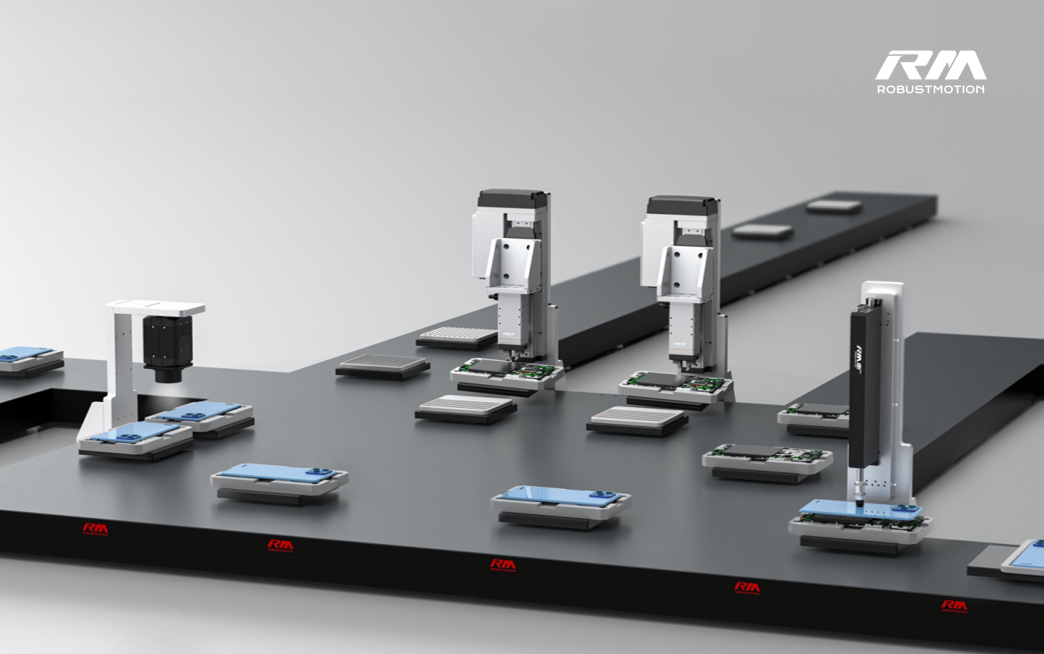
MagiFloater eliminates that assumption. In this planar motor system, multiple independent movers levitate above a modular stator plane and are routed dynamically based on product-specific tasks. One mover diverts to a rework station while another proceeds directly to offload. A third enters a parallel inspection lane without stopping the flow of the rest of the batch. The path is computed, not hard-coded.
For engineers, this means the machine footprint is no longer defined by the longest possible process route. Stations can be added, removed, or reordered without mechanical redesign. The system scales by adding 262 × 262 mm stator modules and multiple-specification movers, not by extending chains or reprogramming entire pallet loops.
From Synchronous Cycle Time to Asynchronous, Event-Driven Flow
The classic conveyor line is a synchronous system. Every pallet advances at the same index, and the line’s throughput is capped by the slowest station. If dispensing takes four seconds and inspection takes one, the entire line runs at four seconds. We have all designed buffer stations and parallel lanes to mitigate this, but the mitigation itself adds mechanical complexity and failure modes.
In a planar motor system like MagiFloater, movers operate independently. Each levitated carrier follows its own velocity profile and dwells only where its specific process demands. While one mover waits at a four-second dispensing station, others continue to inspection, packaging, or return loops. The aggregate throughput becomes a function of mover count, station parallelism, and intelligent scheduling—not the bottleneck station.
With a no-load acceleration of 1.5 G and ±0.02 mm positioning repeatability, the movers are fast and precise enough that the transport time between stations becomes negligible compared to the process time itself. The line is no longer a chain. It is a distributed, event-driven logistics network at the machine level.
From “Convey Then Process” to Integrated 6-DOF Motion
Perhaps the most underappreciated limitation of conventional transfer systems is that they move in two degrees of freedom—X and Y—while most processes require six. To present a part to a vision system, a dispenser, or a precision press, you typically need a rotary stage, a z-axis lift, and a tilt mechanism, each with its own controller, cabling, and maintenance schedule.
MagiFloater’s movers provide six-degree-of-freedom motion: X, Y, Z translation plus rotation and tilt about all three axes, all within a single integrated module. A mover can translate across the plane, rotate 360° continuously, tilt ±2°, and execute vertical motion over a 0.5–5 mm levitation gap—simultaneously. A container can be filled while tilting to control foam. A lens can be oriented to a vision camera while in transit. A microplate can be presented to a pipette tip at the exact angle required, without a separate alignment stage.
This is where the planar motor system transcends the category of “conveyor.” It is a precision motion platform that happens to transport parts. By embedding RobustMotion’s SoftForce® precision force control into the maglev architecture, the same platform can execute delicate assembly and measurement operations with ±0.01 N accuracy, eliminating the need for separate force-controlled actuators in many applications.
A Practical View for System Integrators
From a specification standpoint, a planar motor system like MagiFloater is not a drop-in replacement for a standard belt conveyor. It is a strategic choice for applications where the following conditions apply:
- High mix, low-to-medium volume: Product variants change frequently, and mechanical changeover is a major cost driver.
- Clean or sensitive environments: The contactless levitation eliminates particulate generation from sliding or rolling surfaces—critical in semiconductor, optics, and biomedical production.
- Precision orientation requirements: Processes that currently require rotary tables, lift stations, or robotic reorientation can be simplified into a single maglev motion sequence.
- Space-constrained footprints: The highly integrated stator modules (water-cooled, 24 VDC, networked via Ethernet) reduce the mechanical stack height and cabling density compared to conventional multi-axis transfer systems.
Conclusion
The evolution of production automation has followed a clear arc: first we mechanized, then we servo-controlled, then we networked. The next step is to dissolve the boundary between transport and process. A planar motor system, exemplified by MagiFloater, does not merely move parts more efficiently. It redefines what a “station” is, what a “cycle time” means, and how many mechanical subsystems can be consolidated into a single intelligent motion plane.
For engineers designing systems for 2026 and beyond, the relevant question is no longer “How do I move the part to the process?” It is “How do I make motion itself the process?”